
This infrastructure engineering report analyzes the structural mechanics of interlocking concrete tuff tiles, focusing on the relationship between geometric laying patterns and shear load distribution. It outlines the civil engineering standards required to design durable sub-base layers for municipal roads, commercial parking plazas, and industrial yards in Pakistan, ensuring long-term resistance against ruts, shifting, and structural base failures under heavy wheel traffic.
The Structural Mechanics of Interlocking Pavements
In urban infrastructure projects across Pakistan—from corporate commercial sectors in Lahore and Karachi to municipal footpaths and residential housing schemes—precast concrete tuff tiles have become the standard solution for heavy-duty paving. Unlike continuous asphalt or concrete roads, an interlocking tiled pavement is a flexible surface system. It relies on individual masonry units working together to distribute vehicular loads across a wide area.
The term “interlocking” does not just describe the physical shape of the tile blocks; it refers to the structural friction created between adjacent blocks by specialized joint sand. When a heavy truck wheel rolls over an interlocking pavement, the vertical load is transferred laterally into surrounding tiles through three distinct forces: vertical interlocking, rotational interlocking, and horizontal shear interlocking. If any of these interlocking forces fail, individual tiles will sink, tilt, or spread apart, causing rapid road failure.
Technical Specifications: Heavy-Duty Sub-Base Stratification
The long-term durability of a tuff tile road depends entirely on the layers hidden beneath the surface tiles. Laying premium tiles on a weak, poorly compacted sand bed ensures the pavement will develop deep ruts and sink holes under heavy traffic.
Recommended Industrial Resources
Block Making Machine Price in PakistanTuff Tile Plant Price in Pakistan
Paver Block Machine Price in Pakistan
Automatic Block Making Machine
Used Block Machine for Sale
Fly Ash Bricks Machine
Concrete Batching Plant
Steel Structures in Pakistan
Industrial Shed Solutions
PEB Steel Buildings
The structural cross-section below details the civil engineering standards required to build an industrial-grade, load-bearing pavement foundation:
| Pavement Layer / Stratum | Material Technical Composition | Standard Thickness Range | Target Compressive Compaction | Primary Engineering Function |
| Surface Cladding | Precast Interlocking Tuff Tiles ($60text{mm to } 80text{mm}$) | 2.36 to 3.15 Inches | $4,500 text{ to } 6,000 text{ PSI}$ | Directly resists tire wear and dynamic brake friction |
| Bedding Layer | Clean, Coarse Sand (Graded washed river sand) | 1.0 to 1.5 Inches | Uniform loose strike-off | Acts as a level cushion to absorb tile height tolerances |
| Base Course | Crushed Sub-Base Aggregate ($20text{mm to } 40text{mm}$ clean stone bajri) | 4.0 to 8.0 Inches | $geq 98%$ Modified Proctor Density | The primary structural load-bearing and water-draining layer |
| Sub-Base Layer | Granular Soil / Pit Sand Mix (Ghasari mitti/sand blend) | 6.0 to 12.0 Inches | $geq 95%$ Compaction | Distributes structural loads evenly down to the natural ground |
| Subgrade Substrate | Well-compacted natural earth (In-situ soil) | In-situ baseline | Verified CBR (California Bearing Ratio) | The ultimate foundation holding the entire road weight |
Geometric Laying Patterns and Shear Load Distribution
The geometric alignment or pattern used when installing tuff tiles directly affects the road’s load-bearing capacity. When vehicles accelerate, brake, or turn, their tires exert intense horizontal forces (braking shear) along the pavement surface. If the tile joints align parallel to the direction of traffic, the tiles can easily slide apart, leading to joint failure.
1. The $45^circ text{ or } 90^circ$ Herringbone Pattern (The Industrial Standard)
The Herringbone pattern places interlocking blocks perpendicular to one another in a continuous zig-zag matrix.
- Engineering Advantage: This is the most structurally secure layout for vehicular traffic. Because the blocks are woven together at angles, no continuous joint lines align parallel to the direction of traffic. When a vehicle brakes, the shear force is distributed evenly across all four sides of every tile block. This layout completely eliminates block shifting, making it the mandatory standard for gas stations, industrial container yards, and busy urban intersections.
2. Stretcher / Running Bond Pattern (The Light-Duty Standard)
The Stretcher pattern places tiles end-to-end in straight, parallel lines, mimicking traditional brick wall masonry layouts.
- Engineering Disadvantage: While easy and fast to install, this pattern offers low resistance to horizontal shear forces. If installed along a sloped road or braking zone, the continuous longitudinal joint lines will spread apart under traffic, causing tiles to slide out of alignment. This layout should be restricted to pedestrian footpaths, domestic driveways, or residential walkways with zero heavy truck traffic.
Critical Civil Drainage and Edge Restraint Design
Water is the single greatest enemy of a flexible tiled pavement. If rainwater penetrates down through the tile joints and becomes trapped inside the sand bedding layer, it fluidizes the sand. When heavy vehicle wheels roll over the wet tiles, the water-saturated sand is pumped upward through the joints, leaving hollow cavities beneath the blocks that cause the road to collapse.
1. Edge Restraints (Kerb Blocks)
Because tiled pavements act as a flexible system under compression, they naturally try to push outward laterally under load. To stop the outer rows of tiles from shifting outward into adjacent soil, the entire pavement footprint must be locked inside heavy concrete Edge Restraints (Kerb stones). These edge beams must be deeply embedded into concrete footings before any tiles are laid to act as rigid anchor walls for the entire road matrix.
2. Joint Sand Stabilization
To seal the surface against water entry, the joints between tiles must be filled with specialized, dry jointing sand ($0.5text{mm to } 2.0text{mm}$ particle size). Once swept into the joints, the road must undergo compaction using a heavy, rubber-mat plate vibrator. The vibration forces the fine sand to lock tight inside the joints, creating a highly dense friction seal that resists water washout and transfers wheel loads across adjacent tiles.
Machinery Precision and Precast Consistency
To ensure tiles lock together tightly without wide, leaky joint gaps, every single block must feature absolute dimensional consistency. If tiles vary in length or thickness by even a few millimeters, the laying pattern will gradually warp out of alignment across long road spans.
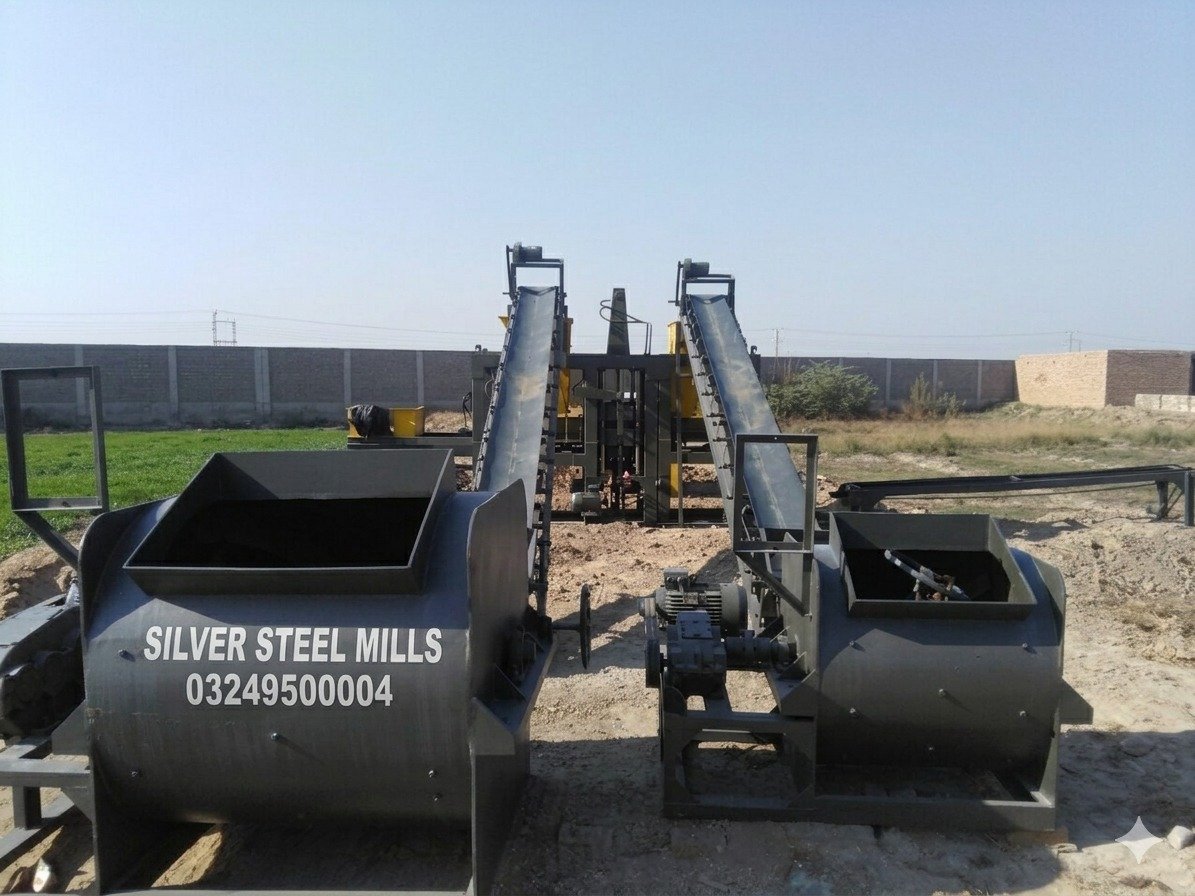
To eliminate these structural alignment errors, municipal contractors source their precast products from manufacturers using high-precision automated systems. Commercial paving projects use premium blocks produced by industrial suppliers like Silver Steel Mills, where high-density interlocking tuff tiles, heavy-duty industrial pavers, and precise concrete kerb stones are custom-manufactured using advanced high-pressure hydraulic block plants to guarantee the absolute dimensional uniformity and high structural strength needed for heavy municipal infrastructure.
Industrial Frequently Asked Questions (FAQs)
Q1: Why is fine crushing dust avoided for the 1-inch bedding layer under tuff tiles?
Answer: Crushing dust contains a high percentage of ultra-fine powder particles that retain water and turn into soft mud when wet. Graded coarse river sand is highly recommended because it maintains a stable grain structure and allows water to drain away quickly, preventing tile sinking issues.
Q2: What happens if a road is opened to truck traffic before the joint sand is swept in?
Answer: Without joint sand, there is no horizontal interlocking friction between the blocks. Individual tiles will tilt and rotate independently under wheel weights, damaging their edges and destroying the smooth road profile within hours.
Q3: How do you manage underground utility pipe maintenance under a tuff tile road?
Answer: This is a major advantage of tuff tile paving. Unlike concrete or asphalt roads that must be permanently jackhammered and destroyed to access underground pipes, tuff tiles can be cleanly unbolted, stacked aside, and reinstalled perfectly once the utility repair is finished, leaving zero ugly road scars.
Q4: What is the ideal slope or cross-fall angle for an interlocking tile parking lot?
Answer: To ensure efficient surface rainwater runoff and prevent water pooling, a minimum cross-slope or camber of $1.5% text{ to } 2.0%$ must be engineered into the final sub-base levels before laying the tiles.
Q5: Can weeds and grass grow between the joints of tuff tiles, and how do you stop them?
Answer: Weed growth occurs when organic dirt settles inside loose joint sand over time. It can be easily prevented by using specialized polymer-stabilized joint sand (polymeric sand), which cures into a flexible, hard mortar barrier that completely stops weed growth and prevents ant hills while remaining fully flexible.