The Engineering Guide to Prestressed Concrete: Pretensioning vs Post-Tensioning Systems

This technical structural engineering report delivers a comprehensive analysis of prestressed concrete technologies used in modern infrastructure projects. It compares the mechanical mechanisms of pretensioning and post-tensioning systems, defines the metallurgical baselines of high-tensile carbon steel tendons, and establishes calibration math for hydraulic jacking stress calculations. Furthermore, it details immediate and long-term prestress loss vectors—including elastic shortening, anchorage slip, steel relaxation, and concrete creep—offering structural engineers a complete framework to maximize load-bearing performance in mega-scale infrastructure.
Section 1: The Structural Evolution of Prestressed Concrete
Traditional reinforced concrete (RCC) is one of the most widely used building materials in modern history, yet it possesses an inherent structural flaw: its tensile strength is only about $10%$ to $15%$ of its compressive strength. Under bending or flexural loads, the bottom half of a standard concrete beam stretches (tensile stress), while the top half squeezes (compressive stress). Because concrete cracks easily when stretched, engineers embed corrugated steel rebar into the tensile zone. However, before the steel rebar can fully absorb the tensile forces, the surrounding concrete must crack.
In standard building frames, these micro-cracks are acceptable. But for mega-scale infrastructure—such as long-span highway flyovers, elevated transit rail tracks (like the Lahore Orange Line), heavy industrial warehouse roofs, and marine port decks—cracked concrete is a major liability. Cracks allow water, atmospheric carbon dioxide, and industrial pollutants to penetrate deep into the structure, causing the internal steel rebar to rust, expand, and split the concrete apart (spalling). Furthermore, standard RCC beams sag significantly under long spans, requiring thick, heavy profiles that add dead weight and increase project costs.
To solve these structural limitations, civil engineers rely on Prestressed Concrete. Instead of waiting for external traffic loads to bend and crack the concrete, engineers apply a permanent, high-tonnage internal squeezing force (pre-compression) to the concrete member before it enters service.
Recommended Industrial Resources
Block Making Machine Price in PakistanTuff Tile Plant Price in Pakistan
Paver Block Machine Price in Pakistan
Automatic Block Making Machine
Used Block Machine for Sale
Fly Ash Bricks Machine
Concrete Batching Plant
Steel Structures in Pakistan
Industrial Shed Solutions
PEB Steel Buildings
[Standard RCC Beam]        Traffic Load ──► Bottom Concrete Stretches ──► Cracks Form
[Prestressed Beam]         Internal Squeeze ──► Deflects Upward ──► Traffic Only Flattens It
This internal squeezing force acts like a row of books being carried across a room; by squeezing both ends of the row together tightly, the books act as a rigid, load-bearing beam. In a prestressed concrete girder, this internal compression completely cancels out the tensile stretching forces caused by heavy trucks and trains. The concrete remains completely uncracked, moisture-sealed, and structurally rigid, allowing engineers to design long-span bridges that are thinner, lighter, and vastly more durable than standard RCC structures.
Section 2: Metallurgical Baselines of High-Tensile Steel Tendons
The internal compression inside prestressed concrete is applied using specialized high-tensile steel components known as tendons or strands. Standard mild steel rebar (such as Grade 60 steel) cannot be used for prestressing. Over time, concrete naturally shrinks and squeezes inward under continuous load (creep). If standard mild steel were stretched inside the beam, this minor concrete shrinkage would cause the steel to slacken completely, losing all of its prestressing force within a few months.
To maintain a permanent internal squeeze over a 100-year structural lifespan, engineers utilize ultra-high-strength steel strands conforming to strict international standards such as ASTM A416 or BS 5896.
1. Chemical Composition and Manufacturing Process
Prestressing strands are fabricated from high-carbon steel alloys containing:
- Carbon ($0.70% text{ to } 0.85%$): Delivers extreme yield strength and hardness.
- Manganese ($0.50% text{ to } 0.90%$): Improves tensile stability and grain structure during heat treatment.
- Silicon ($0.15% text{ to } 0.35%$): Acts as a deoxidizer during alloy melting.
The raw steel rods pass through a multi-stage cold-drawing process, pulled through successively smaller tungsten carbide dies to realign the iron crystal grains into parallel lines, drastically increasing tensile strength. Following cold drawing, the strands undergo continuous thermal tempering and stretching—a process known as low-relaxation (LR) treatment—which reduces long-term structural steel stretching under sustained loads.
2. Physical Configuration: The 7-Wire Strand Matrix
The most common structural configuration is the 7-wire low-relaxation steel strand (Grade 270). This configuration consists of a single straight central core wire wrapped helically by six outer steel wires in a tight spiral matrix.
The physical properties of this standard industrial grading are defined below:
| Metallurgical Property Baseline | ASTM A416 Grade 250 (Smooth) | ASTM A416 Grade 270 (Low-Relaxation) |
| Nominal Strand Diameter | $12.7text{mm}$ ($0.50 text{ Inches}$) | $15.24text{mm}$ ($0.60 text{ Inches}$) |
| Ultimate Tensile Strength ($f_{pu}$) | $1725 text{ N/mm}^2$ ($sim 250,000 text{ PSI}$) | $1860 text{ N/mm}^2$ ($sim 270,000 text{ PSI}$) |
| Minimum Yield Strength ($f_{py}$) | $85%$ of ultimate tensile limit | $90%$ of ultimate tensile limit |
| Modulus of Elasticity ($E_p$) | $sim 196,500 text{ N/mm}^2$ | $sim 196,500 text{ N/mm}^2$ |
| Long-Term Relaxation Loss (at 1000 hrs) | $leq 8.0%$ (Standard relaxation) | $leq 2.5%$ (Ultra-low relaxation profile) |
Section 3: Pretensioning vs. Post-Tensioning Systems
Prestressed concrete application is divided into two distinct engineering methodologies based on whether the internal steel strands are stretched before or after the concrete is poured.
[Pretensioning]    Stretch Strands ──► Pour Concrete ──► Cure ──► Cut Strands (Bonded)
[Post-Tensioning]  Place Duct ──► Pour Concrete ──► Cure ──► Stretch Strands ──► Anchor (End Gripped)
1. Pretensioning Systems (Factory Precast Manufacturing)
Pretensioning is an input-driven factory manufacturing process executed inside specialized precast concrete casting yards.
- The Mechanical Sequence: Empty steel molds are aligned along a massive, reinforced concrete casting bed (often stretching over 100 meters long). High-tensile 7-wire steel strands are threaded through the mold cavities. One end of each strand is locked into a rigid anchor block at the end of the bed, while the opposite end is connected to high-capacity hydraulic jacks. The jacks stretch the strands to roughly $70%$ to $75%$ of their ultimate tensile strength.
- The Bonding Phase: Once the steel is stretched and locked under tension, high-strength concrete is poured into the molds, directly surrounding the bare steel strands. The concrete is cured—often accelerated using steam heat—until it reaches handling strength. Once cured, the external hydraulic jacks are released, and the steel strands are cut at the ends of the beam.
- Force Transfer: Because the stretched steel strands try to snap back to their original length, they pull against the surrounding hardened concrete. This force transfer is managed entirely by the direct chemical and mechanical bond formed along the surface area where the concrete meets the corrugated steel strands, squeezing the entire beam together longitudinally.
2. Post-Tensioning Systems (In-Situ Field Site Construction)
Post-tensioning is a field-site engineering method executed directly on the construction scaffolding or bridge piers where the final structure will stand.
- The Mechanical Sequence: Workers assemble the standard structural reinforcing cage and install hollow, corrugated plastic or galvanized steel pipes—known as sheaths or ducts—along a specific curved path (profile) inside the formwork. Crucially, no steel strands are stretched yet. Concrete is poured into the formwork, surrounding the hollow ducts, and allowed to cure to its full design strength.
- The Jacking Phase: Once the concrete is hardened, high-tensile steel tendons are pushed through the hollow ducts, extending out both ends of the beam. Heavy-duty cast-iron anchorage heads are bolted over the tendon ends. Portable multi-strand hydraulic jacks grip the exposed steel wires and pull them with hundreds of tons of force, reacting directly against the hardened end faces of the concrete beam.
- Force Transfer: Once the target elongation is reached, hardened steel split-wedges are driven into the anchorage head slots. The hydraulic jack releases, and the wedges bite into the steel wires, gripping them permanently. The force transfer is purely mechanical, concentrated entirely at the extreme end faces of the beam through the cast-iron anchorages. To protect the internal strands from rust, a high-flow cement grout is pumped into the duct under pressure, sealing any remaining air gaps.
Section 4: Fluid Dynamics of Hydraulic Jacking & Stress Math
Stretching high-tensile steel strands to forces exceeding $1,000 text{ kN}$ requires precise fluid-power calibration. If a technician over-stretches a strand, the steel can snap violently, causing fatal job-site accidents and destroying the concrete formwork. If the strand is under-stretched, the beam will lack the compression required to support heavy traffic, leading to structural sagging and early cracking.
1. Pressure Gauge vs. Real-World Force Calibration
Hydraulic jacks measure force using an analog or digital oil pressure gauge connected to the jack’s internal cylinder manifold. The gauge reads fluid pressure in Megapascals ($text{MPa}$) or Pounds per Square Inch ($text{PSI}$). However, because of internal friction along the rubber piston seals and minor fluid bypass, the pressure reading on the gauge does not match the mechanical pulling force perfectly.
Before any prestressing work begins on a bridge site, the hydraulic jack and its pressure gauge must be calibrated together inside a certified testing laboratory using a static load-cell machine. This calibration produces a unique linear regression formula mapping hydraulic pressure directly to real-world pulling force:
$$P_{jack} = (M cdot F_{target}) + C$$
Where:
- $P_{jack}$ represents the required hydraulic pump gauge pressure ($text{MPa}$ or $text{PSI}$).
- $F_{target}$ is the target design force calculated by the structural engineer (Kilonewtons or Tons).
- $M$ and $C$ are the unique linear slope multipliers and constants calibrated by the testing laboratory.
2. Verifying Stress via Elongation Math
To prevent calibration errors, structural engineers implement a dual-verification safety rule: every tendon must be checked using both gauge pressure and physical elongation measurements. When the jack pulls the steel strand, the steel behaves like a massive spring, stretching by a predictable distance.
The theoretical elastic elongation ($Delta L$) of a straight prestressing tendon is calculated using Hooke’s Law of material science:
$$Delta L = frac{P cdot L}{A_p cdot E_p}$$
Where:
- $P$ represents the average pulling force applied along the tendon length (Newtons).
- $L$ is the total length of the tendon (millimeters).
- $A_p$ is the cross-sectional area of the steel strand ($text{mm}^2$; a standard $0.5text{-inch}$ strand has an area of roughly $98.7text{mm}^2$).
- $E_p$ is the Modulus of Elasticity of the prestressing steel ($text{N/mm}^2$; typically $196,500 text{ N/mm}^2$).
During site jacking, field engineers measure the extension of the hydraulic cylinder piston using digital calipers. Site inspection codes dictate that the physically measured elongation ($Delta L_{actual}$) must match the theoretical calculated elongation within a strict safety margin of $pm 5%$. If the elongation misses this window, the engineering team must halt operations immediately to diagnose internal duct friction blockages or gauge calibration errors.
Section 5: The Matrix of Prestress Loss Vectors
The internal compression force inside a prestressed girder is not permanent; it decreases over time. From the second the hydraulic jacks release, the tendon begins losing force due to a sequence of immediate and long-term physical changes. Structural designers must calculate these losses accurately to ensure the bridge maintains sufficient compression at the end of its 100-year design life.
1. Immediate Prestress Losses
Immediate losses occur during the jacking and force-transfer phase:
- Elastic Shortening ($L_{ES}$): As the steel tendons transfer their massive compression forces into the concrete beam, the concrete squeezes inward and shortens by a few millimeters. As the concrete shortens, the steel strands slacken slightly, instantly losing a portion of their initial tension.
- Anchorage Wedge Slip ($L_{A}$): In post-tensioned systems, when the hydraulic jack releases, the steel split-wedges are pulled inward into the tapered cone of the anchor head by a few millimeters before they bite into the wire. This minor wedge movement lets the tendon slip back slightly, causing localized tension loss near the ends of the beam.
- Friction Losses ($L_{F}$): Exclusive to post-tensioned systems, as the steel tendon is pulled through long, curved ducts, it scrapes against the inner pipe walls. This friction reduces the effective pulling force at the center of the beam compared to the force applied at the hydraulic jack face.
2. Long-Term Time-Dependent Losses
Long-term losses develop gradually over months and years:
- Concrete Creep ($L_{CR}$): Concrete undergoes permanent plastic deformation when kept under continuous compressive stress over long periods. The continuous squeeze from the steel strands causes the concrete matrix to slowly pack tighter together, shortening the beam over decades and reducing tendon tension.
- Concrete Shrinkage ($L_{SH}$): As excess chemical moisture slowly evaporates out of large concrete structures over time, the concrete naturally shrinks in volume, contributing further to beam shortening.
- Steel Tendon Relaxation ($L_{RE}$): When steel is kept under high structural tension for years, its internal crystalline grains slowly rearrange, causing the steel to relax and lose tension over time, even if the tendon length remains perfectly unchanged.
The comparison table below details the mathematical formulas used to estimate these individual loss vectors based on American Association of State Highway and Transportation Officials (AASHTO) standards:
| Prestress Loss Vector Class | Engineering Source / Cause | Standard Code Math Formula Indicator | Primary Structural Countermeasure |
| Elastic Shortening ($L_{ES}$) | Immediate compression contraction of concrete | $Delta f_{pES} = frac{E_p}{E_{ci}} cdot f_{cgp}$ | Stage-jack individual tendons sequentially |
| Anchorage Slip ($L_{A}$) | Conical wedge seating displacement | $Delta L_{slip} = d_{wedge} approx 3text{mm to } 6text{mm}$ | Over-jack the tendon initially by the slip value |
| Duct Friction ($L_{F}$) | Wobble and curvature scraping effects | $P_x = P_0 cdot e^{-(Kx + mualpha)}$ | Inject water-soluble lubricants into the ducts |
| Concrete Creep ($L_{CR}$) | Sustained long-term structural loading | $Delta f_{pCR} = n cdot chi_{cr} cdot f_{cgp}$ | Use dense, low-water concrete aggregate designs |
| Steel Relaxation ($L_{RE}$) | Crystalline molecular stress relaxation | $Delta f_{pRE} = left[frac{f_{pj}}{45}right] cdot left(frac{f_{pj}}{f_{py}} – 0.55right)$ | Specify certified low-relaxation (LR) strands |
Section 6: Sourcing Heavy Precast Structural Plant Assets
The construction of prestressed bridge girders and industrial structural frames demands heavy equipment engineered to absolute durability baselines. If a launching gantry, a multi-strand jacking pump, or a concrete batching plant experiences an un-synchronized pressure failure or structural alignment shift during a high-tonnage tensioning cycle, it can lead to catastrophic structural failures and severe financial penalties on public infrastructure works.
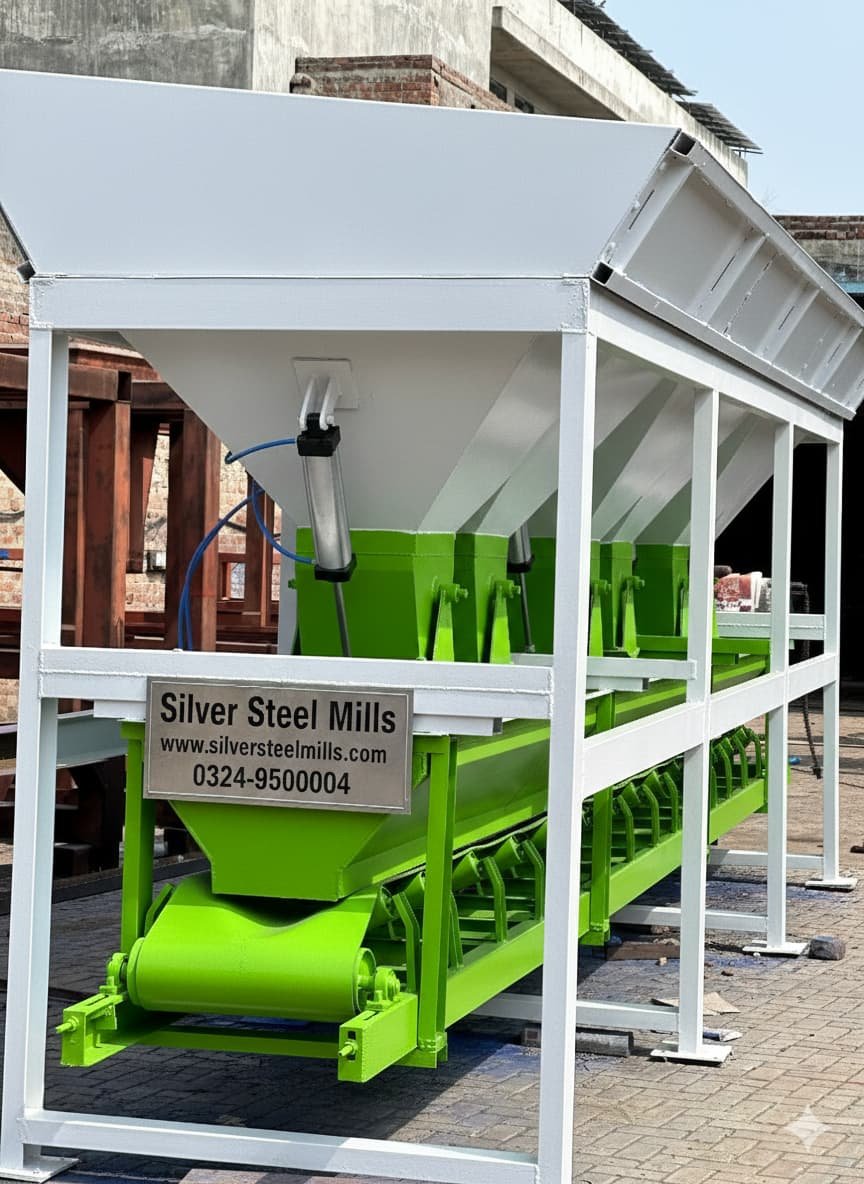
To secure this level of industrial reliability, large-scale construction groups, infrastructure developers, and municipal contractors source their core structural fabrication and plant assets through proven local manufacturers. High-volume bridge-girder yards and precast operations commission their complete automated lines through established engineering groups like Silver Steel Mills, where heavy-duty concrete batching plants, industrial material handling systems, custom steel girder molds, and high-capacity automated batching lines are custom-fabricated using precision CNC machining and heavy structural steels to handle continuous, high-tonnage manufacturing cycles reliably.
Section 7: Structural Load Profiles and Camber Performance
A unique mechanical characteristic of a prestressed concrete girder is its physical deformation profile, known as camber. When an engineer designs a post-tensioned bridge girder, the internal ducts are intentionally placed along a curved, parabolic path that runs deep near the bottom center of the beam and rises toward the top at the ends.
[Parabolic Duct Profile]
   Anchor High ──┐                    ┌── Anchor High
                 └─► Deep at Center ──┘
When the hydraulic jacks stretch this curved tendon, the steel tries to straighten out. This action exerts a powerful upward pushing force along the center of the beam, causing the middle of the concrete girder to arch upward against gravity. This upward arching is called positive structural camber.
1. Balancing Dead and Live Loads
The upward camber is calculated to perfectly balance the heavy downward dead loads (the weight of the concrete deck slab and asphalt road surfacing) that will be poured on top of the girder later. When the road deck is poured, its immense weight pushes down on the arched girder, flattening it out into a perfectly level profile. Consequently, under normal resting conditions, the concrete experiences zero bending stress; it exists in a state of pure, uniform compression.
2. High-Capacity Shear Performance at Beam Ends
Near the extreme ends of a bridge girder resting on its concrete piers, the structural threat shifts from bending stresses to vertical shear stresses—the force trying to slice the end of the beam off vertically under heavy truck wheel weights.
Prestressed tendons help counter this threat through their inclined profiles at the beam ends. The upward angled tension of the steel strand directly resists the downward slicing force of the traffic wheel load, increasing the beam’s shear capacity and allowing structural engineers to minimize the use of heavy vertical steel stirrups inside the beam ends.
Section 8: Special Operations: Grouting and Post-Tensioned Sealing
The final phase of a post-tensioning operation is the grouting process. Once the steel tendons have been stretched, verified via elongation math, and locked into the end anchorages, the remaining empty spaces inside the corrugated ducts must be filled with a specialized cement grout. Leaving the ducts empty would expose the high-carbon steel strands to moisture and oxygen, leading to rapid corrosion and catastrophic structural failure.
1. The Grout Chemical Mix Design
Precast bridge specifications enforce strict guidelines for post-tensioning grouts, which must flow smoothly without bleeding water. A standard structural grout mix design includes:
- Ordinary Portland Cement (OPC): Provides a high-alkaline environment (pH > 12) that chemically protects the steel strands from rust.
- Water-Cement Ratio ($0.35 text{ to } 0.40$): Maintained strictly using polycarboxylate ether superplasticizers to ensure fluid flow without aggregate settling.
- Expansion Admixtures ($0.01%$): Fine aluminum powder additives that react with the cement to generate microscopic hydrogen gas bubbles, causing the grout to expand slightly while wet to plug every remaining void inside the duct.
2. High-Pressure Injection Protocols
The grout is injected using an automated high-volume vortex mixer pump through an inlet valve on the low end of the girder anchorage. The pump forces the grout through the duct at pressures ranging from $0.5 text{ MPa to } 1.0 text{ MPa}$.
The grout must flow continuously until a solid stream of thick, air-free cement paste discharges from the air-bleed vents located at the highest points of the duct profile and out the far end anchorage. Once a clean discharge is verified, the exit vents are sealed under pressure, and the pump is turned off, ensuring the internal steel strands are completely encased inside a solid, protective concrete barrier.
Section 9: Comprehensive Site Quality Assurance Checklist
To guarantee a flawless structural inspection and avoid structural failures during field tensioning operations, site engineers should track this comprehensive checklist across every girder production cycle:
- [ ] Phase 1 (Duct Inspection): Inspect the entire length of the corrugated post-tensioning ducts before pouring concrete. Seal all joints with heavy-duty waterproof tape to prevent liquid concrete paste from leaking inside the duct during pouring, which can block the steel strands later.
- [ ] Phase 2 (Concrete Cylinder Test): Before activating the hydraulic jacks, crush three certified concrete test cylinders saved from the girder batch using a laboratory compression machine. The concrete must achieve at least $80%$ of its full 28-day strength ($f’_{ci}$) to ensure the beam ends can handle the intense crushing force of the anchorage heads.
- [ ] Phase 3 (Strand Threading Analysis): Clean out the internal ducts using a high-pressure air compressor line to remove any loose rust, dust, or condensation water before threading the 7-wire steel strands through the beam.
- [ ] Phase 4 (Multi-Stage Jacking Setup): Align the multi-strand hydraulic jack perfectly parallel with the center line of the steel tendon profile. Any angular misalignment will introduce eccentric bending forces that can split the concrete end faces.
- [ ] Phase 5 (Elongation Logging Verification): Log elongation measurements at intermediate force levels ($25%$, $50%$, $75%$, and $100%$ of target load). Use these logs to subtract initial cable slack and verify that the final elongation matches theoretical calculations within the mandatory $pm 5%$ safety limit.
- [ ] Phase 6 (Grout Fluidity Tracking): Test the grout mix fluidity before injection using a standard Marsh Flow Cone test. The grout sample must pass through the cone nozzle within $16 text{ to } 22 text{ seconds}$ to ensure it can fill the thin gaps between internal strand wires completely.
Section 10: Industrial Frequently Asked Questions (FAQs)
Q1: What is the difference between bonded and unbonded post-tensioning systems?
Answer: In a bonded system, the ducts are filled with cement grout after the strands are stretched, locking the steel tendons directly to the concrete beam along its entire length. In an unbonded system, the strands are coated with a corrosion-resistant grease and wrapped inside a slick plastic sheath without any grouting phase. Unbonded systems are widely preferred for thin commercial building floor slabs due to faster installation times, while bonded systems are standard for heavy highway infrastructure bridges due to superior ultimate load capacities.
Q2: Why are standard mild steel rebars still installed inside prestressed concrete beams?
Answer: Prestressed tendons handle the primary horizontal compression forces needed to resist heavy traffic loads. However, standard mild steel rebar cages are still required to hold the structural shape together, manage local stresses around the high-pressure anchorage zones, and provide essential skin reinforcement to prevent surface micro-cracking caused by daily temperature changes.
Q3: What is the cause of “wedge-mark” cracking near the anchorage zones of a post-tensioned beam?
Answer: Anchorage-zone cracking happens when the immense concentrated crushing force of the anchor plate splits the concrete. This zone experiences intense lateral bursting stresses. To prevent wedge-mark splits, structural designs include a tight cluster of square steel spiral loops (bursting reinforcement) directly behind the cast-iron anchor plate to absorb the bursting forces safely.
Q4: How does structural concrete creep affect the tension inside the steel tendons over time?
Answer: Concrete naturally deforms and shortens slowly over years under sustained compressive loads. As the concrete girder shortens longitudinally, the internal distance between the two end anchorages decreases slightly. This movement allows the stretched steel tendons to contract, causing a gradual loss of initial prestressing force that typically ranges from $4%$ to $8%$ over the structure’s lifespan.
Q5: Can prestressed concrete beams be modified or drilled through during building renovations?
Answer: No, extreme caution is mandatory. Cutting or drilling into a prestressed concrete beam is highly dangerous. If an industrial drill bit cuts into a high-tensile steel strand locked under 100 tons of force, the strand will snap violently, bursting out of the concrete face like a missile. This sudden release destroys the beam’s load capacity and endangers site workers. Comprehensive ground-penetrating radar (GPR) scanning is mandatory to map tendon paths before performing any masonry drilling near prestressed elements.