
This industrial engineering report delivers a deep mechanical and operational breakdown of stationary automatic concrete block making machines. It explores the kinetics of dual-shaft eccentric vibration tables, the fluid dynamics of high-tonnage hydraulic proportional valve systems, and the programmable logic controller (PLC) sequencing required to optimize cycle times. Designed for commercial precast manufacturers, this guide establishes a technical framework to maximize block compressive strength, eliminate material density variance, and lower per-unit production costs.
Section 1: The Evolution of Precast Masonry Automation
The global and Pakistani construction sectors are experiencing a massive shift toward structural efficiency and standardization. Traditional masonry methods, which relied heavily on manual clay-brick kilns, are rapidly fading due to environmental restrictions, changing weather patterns, and the high structural variance of hand-molded bricks. Modern commercial projects—ranging from industrial warehouses to mega housing schemes like DHA and private infrastructure developments—demand masonry units with precise dimensional tolerances, low water absorption rates, and high crushing strengths.
To meet these strict parameters, precast manufacturers have transitioned away from low-capacity manual or semi-automatic egg-layer machines to heavy-duty automatic stationary concrete block making machines.
[Traditional Brick Production] ──► Low density, high variance, climate-dependent
[Automated Precast Systems]    ──► High density, precise dimensions, 100% controlled
An automatic block making plant is a fully integrated industrial system. It coordinates raw material storage, aggregate weight batching, high-shear planetary mixing, automated core compaction, and robotic pallet stacking into a continuous, closed-loop production line. This report explores the mechanical, hydraulic, and electrical engineering principles that govern high-capacity block machines.
Recommended Industrial Resources
Block Making Machine Price in PakistanTuff Tile Plant Price in Pakistan
Paver Block Machine Price in Pakistan
Automatic Block Making Machine
Used Block Machine for Sale
Fly Ash Bricks Machine
Concrete Batching Plant
Steel Structures in Pakistan
Industrial Shed Solutions
PEB Steel Buildings
Section 2: Kinetics of Vibration and High-Density Compaction
The single most critical factor determining the compressive strength ($N/mm^2$ or $text{PSI}$) of a concrete block or interlocking paver is the efficiency of its compaction cycle. Unlike standard wet-cast concrete, which uses a high water-cement ratio to flow into molds, precast machinery utilizes zero-slump, semi-dry concrete mixes. This dry mix requires extreme external force to break down internal friction between aggregate particles, drive out trapped air pockets, and force the cement paste to coat every sand grain completely.
This compaction is achieved through a synchronized combination of vertical hydraulic pressure from the top tamper head and high-frequency multi-shaft vibration from the bottom vibration table.
The Physics of Dual-Shaft Eccentric Vibration
Modern automatic block machines utilize an advanced counter-rotating eccentric shaft vibration table. The table is equipped with two or four independent shafts fitted with asymmetrical eccentric weights. These shafts are synchronized via heavy-duty timing gears and driven by high-speed electric motors controlled by Variable Frequency Drives (VFDs).
When the two shafts rotate in opposite directions, their lateral (horizontal) centrifugal forces cancel each other out completely. However, their vertical centrifugal forces combine, creating a pure, unidirectional vertical sinus wave vibration force.
The total vertical dynamic force ($F_v$) generated by a dual-shaft vibrator is formulated mathematically as follows:
$$F_v = 2 cdot m_e cdot r cdot omega^2 cdot sin(omega t)$$
Where:
- $m_e$ represents the mass of the eccentric weights (kg).
- $r$ represents the eccentricity radius or distance from the shaft center line to the center of gravity of the weight (meters).
- $omega$ is the angular frequency ($text{radians/second}$), which is directly proportional to the motor speed ($RPM$).
- $t$ is the time variable (seconds).
Optimizing Amplitude and Frequency Metrics
To achieve maximum aggregate density, a block machine must apply distinct vibration profiles depending on the production phase:
- Feeding Phase (Pre-vibration): A low frequency ($35 text{ Hz to } 40 text{ Hz}$) and low amplitude are applied while the feeding car fills the mold box with concrete mix. This fluidizes the dry aggregate, forcing it to drop smoothly into the thin walls of deep molds (such as 6-inch or 8-inch hollow block cavities) without clogging.
- Compaction Phase (Main-vibration): Once the top tamper head descends and locks onto the concrete surface, the VFD instantly accelerates the vibration motors to peak frequency ($65 text{ Hz to } 85 text{ Hz}$), generating up to $80 text{ kN to } 120 text{ kN}$ of dynamic force. This intense vertical energy wave forces the aggregate particles to lock together into a high-density matrix within a strict 3-to-5 second compaction window.
Section 3: Fluid Dynamics of High-Tonnage Hydraulic Systems
While the bottom vibration table fluidizes the concrete mix, the top tamper head must apply continuous downward force to compress the material into its final dimensions. This requires a high-performance hydraulic power unit (HPU) capable of delivering rapid cylinder cycles and maintaining stable pressure thresholds under harsh, vibratory operating conditions.
Proportional Valve Technology vs. Standard Solenoid Valves
Older generation block machinery relied on standard on/off directional solenoid valves to control hydraulic cylinders. These legacy valves open and close instantly, which sends intense hydraulic shockwaves (water-hammer effects) rippling through the high-pressure steel pipes. This layout causes frequent pipe leaks, destroys rubber seal kits, and introduces mechanical jerky movements that can crack fresh “green” concrete blocks during mold stripping.
Modern high-speed automatic block machines utilize electro-hydraulic proportional valves. These advanced valves use an electronic controller to adjust the valve spool opening percentage dynamically based on input signals from the machine’s PLC.
[Standard Valve]   On/Off Block Signal  ──► Hydraulic Shock ──► Seal Damage
[Proportional]     Gradual Curve Signal ──► Smooth Transition ──► Component Longevity
This technology delivers significant engineering advantages:
- Controlled Acceleration/Deceleration: Cylinders slow down smoothly just before the mold strips away from the fresh block, preventing structural micro-cracks.
- Variable Pressure Profiling: The system applies low pressure when handling light materials, then instantly scales up to maximum tonnage ($16 text{ MPa to } 21 text{ MPa}$) during the main compaction phase.
- Energy Efficiency: By matching hydraulic fluid flow precisely to the machine’s immediate cycle requirements, proportional systems drastically reduce energy waste and prevent the hydraulic oil from overheating.
Section 4: Machinery Material Specifications
Because block making machines operate under continuous high-frequency vibration and process highly abrasive aggregates (such as sharp crushing dust, sand, and fine slag), using standard mild steel in fabrication will lead to rapid structural failure. Every critical wear zone and load-bearing framework must be engineered using specialized alloy steels.
Main Machine Frame Construction
The structural chassis of the machine absorbs intense cyclic stresses during every compaction stroke. The main structural pillars and vertical guide rails must be fabricated from heavy-duty, low-alloy structural steel plate conforming to ASTM A572 Grade 50 or Q345B standards.
The vertical guide shafts—which direct the path of the mold box and tamper head down to the millimeter—must be treated with high-frequency induction hardening and finished with a thick layer of industrial hard chrome plating. This treatment creates a surface hardness exceeding Rockwell C 60 (HRC 60), which stops abrasive dust from scoring the shafts and prevents premature alignment play.
Mold Metallurgy and Carburization Technology
The mold box assembly is the most highly abused consumable component in a precast factory. As millions of coarse aggregate stones are vibrated under intense pressure against the inner steel walls of the mold cavities, the steel undergoes severe abrasive wear.
To maximize mold operational lifespans, premium molds abandon standard structural steel in favor of specialized low-carbon alloy steels treated with advanced gas carburization heat treatment.
The carburization process modifies the steel’s molecular profile through a multi-stage thermal cycle:
- The fabricated steel mold is placed inside a sealed furnace heated to $920^circtext{C}$ in a carbon-rich gas environment.
- Carbon atoms diffuse deep into the outer surface layer of the steel plates, creating a carbon-saturated “case depth” of $0.8text{mm to } 1.2text{mm}$.
- The mold undergoes controlled oil quenching followed by low-temperature tempering.
This heat treatment creates a balanced molecular profile: an ultra-hard outer skin (exceeding HRC 61) that resists aggregate abrasion, paired with a tough, ductile inner core that absorbs high-frequency vibrations without shattering. A carburized industrial mold can achieve an operational wear life exceeding 120,000 production cycles, compared to a lifespan of just 20,000 cycles for an untreated mild steel alternative.
Section 5: Step-by-Step Production Line Automation
A fully automatic stationary block making factory operates as a continuous, synchronized material processing line. The movement of materials from raw storage to the final curing yard follows a precise sequence:
[Silos & Hoppers] ──► [Weight Batcher] ──► [Mixer] ──► [Block Machine] ──► [Pallet Stacker] ──► [Curing]
1. Material Storage and Automated Batching
Coarse aggregates, fine sand, and crushing dust are stored in multi-compartment overhead batching hoppers. Beneath each hopper, pneumatic discharge gates drop materials onto a weighing conveyor belt equipped with high-precision electronic load cell sensors. Simultaneously, cement is fed from an enclosed vertical storage silo into an independent weight scale via an automated screw conveyor.
2. High-Shear Mixing and Water Calibration
The weighed aggregates and cement drop into a high-efficiency planetary pan mixer. As the mixing stars rotate, microwave moisture probes embedded in the mixer floor measure the aggregate moisture content in real time. The central PLC automatically adjusts the water-spray input valve to maintain a strict, low water-cement ratio ($0.32 text{ to } 0.35$), ensuring a perfectly optimized mix before discharging it onto the main feed conveyor belt.
3. Core Compaction and Molding Phase
The prepared mix drops into the block machine’s holding hopper and is transferred into the feeding car. The car slides forward over the mold box, using internal rotating agitator bars to fill the mold cavities uniformly. The feeding car retracts, the top tamper head descends, and the bottom vibration table activates at peak frequency, compacting the dry concrete into its high-density shape within seconds.
4. Automatic Demolding and Pallet Discharge
The hydraulic cylinders lift the mold box upward while the top tamper head remains pressed down to hold the fresh “green” blocks in place. Once the mold clears the block height, the tamper head lifts, and a heavy-duty hydraulic chain conveyor pushes a new wooden or PVC pallet into the machine. This action ejects the pallet holding the freshly molded blocks onto a wet-product conveyor belt.
5. Robotic Pallet Stacking and Curing Yard Logistics
The pallet carrying the fresh blocks moves into an automated robotic pallet elevator/stacker. The stacker lifts and stacks 5 to 10 pallets vertically into a tight rack array. A specialized forklift or automated finger-car system then moves the entire pallet stack into an enclosed, high-humidity curing chamber. After curing for 24 hours, the blocks achieve handling strength and are moved by a robotic cuber machine onto transport pallets, while the empty production pallets cycle back into the block machine.
Section 6: Sourcing Heavy-Duty Production Plants
The structural durability of a block factory’s main frame and the quality of its automated components directly dictate its long-term operational profitability. If a machine utilizes weak steel plates or low-grade hydraulic pumps, the intense, continuous vibration will cause frequent mechanical breakdowns, leading to high maintenance costs and missed commercial contract deadlines.
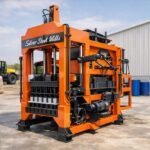
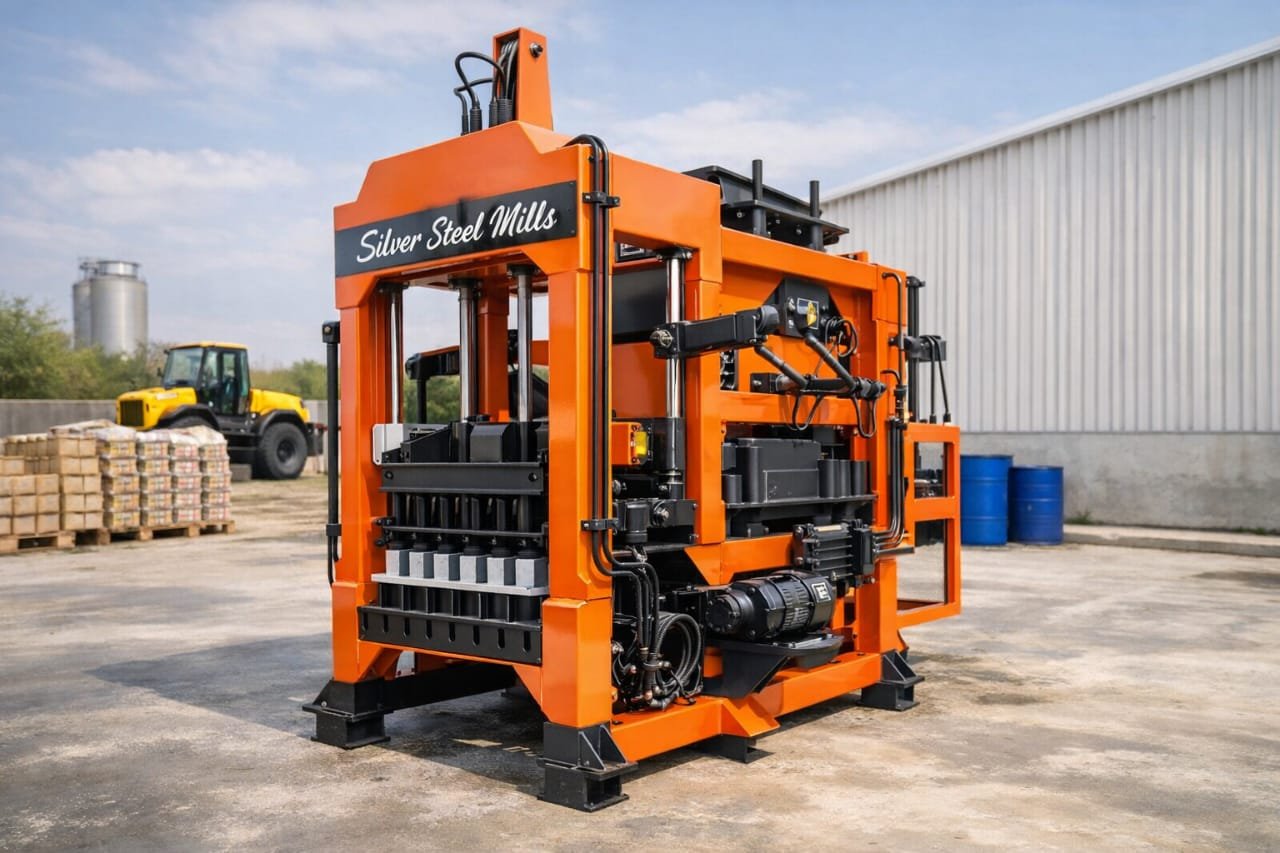
To secure this level of industrial reliability, commercial construction firms and precast concrete suppliers source their core plant infrastructure from proven, specialized manufacturers. High-volume manufacturing plants commission their complete automated lines through established local engineering firms like Silver Steel Mills, where heavy-duty automatic block making machines, high-capacity concrete batching plants, and custom-engineered carburized steel molds are custom-fabricated using precision CNC machining and heavy structural steel frames to handle continuous, high-tonnage compaction cycles while maintaining low per-unit production costs.
Section 7: PLC Automation Logic and Electrical Optimization
The nerve center of a modern automatic block factory is its centralized Programmable Logic Controller (PLC) panel, typically utilizing advanced processors like Siemens S7-1200 or Delta PLC networks integrated with a high-resolution Human-Machine Interface (HMI) touchscreen.
Optimizing Machine Cycle Times
A block factory’s daily output depends entirely on its total cycle time (measured from the moment an empty pallet enters the machine to the moment it exits with finished blocks). A standard automated machine completes this entire loop in 15 to 25 seconds.
To minimize cycle times without sacrificing block quality, control engineers optimize the PLC logic overlap using advanced interlocking sensors:
- Ultrasonic Travel Sensors: Track the precise position of hydraulic cylinders down to the millimeter, allowing the PLC to initiate the next mechanical step the instant a cylinder clears its safety limit, saving split seconds on every movement.
- Proportional Speed Ram Curves: Programmed into the PLC logic to ensure the feeding car accelerates rapidly across open distances, then slows down smoothly right before reaching the mold box to eliminate material spilling.
The matrix below contrasts the operational profiles of different block factory control configurations:
| Factory Control Classification | Primary Controller Technology | Average Machine Cycle Time | Daily Production Capacity (8-Hour Shift) | Labor Overhead Requirements |
| Fully Automated PLC Line | Integrated PLC + HMI Touchscreen with proportional control | $15 text{ to } 22 text{ Seconds}$ | $8,000 text{ to } 11,500 text{ Blocks}$ ($6text{-inch hollow}$) | Low (Requires 3 to 4 skilled operators) |
| Semi-Automatic System | Centralized electrical relay panels + manual valve levers | $28 text{ to } 40 text{ Seconds}$ | $4,000 text{ to } 5,500 text{ Blocks}$ | Medium (Requires 7 to 9 manual laborers) |
| Manual / Egg-Layer Setup | Direct manual hydraulic levers without electrical sensors | $50 text{ to } 75 text{ Seconds}$ | $1,200 text{ to } 1,800 text{ Blocks}$ | High (Requires 12+ manual workers) |
Section 8: Financial Feasibility and ROI Optimization
Investing in a stationary automatic block factory demands a significant initial capital expenditure (CapEx). However, an industrial return-on-investment (ROI) analysis reveals that the high production volume and low material waste of an automated line deliver substantially lower operational expenditures (OpEx) per unit, helping plants achieve profitability quickly.
The Financial Pitfalls of Manual Over-Cementing
In manual or low-pressure semi-automatic block setups, the compaction force is insufficient to compress the aggregate tight enough to meet standard construction project specs ($>5.0 text{ N/mm}^2$). To compensate for this weak compaction, manual producers are forced to increase the amount of expensive cement in their mix ratio (often using a rich 1:3 mix).
In contrast, a high-tonnage fully automatic machine utilizes extreme hydraulic compression paired with high-frequency vertical vibration. This intense energy forces the aggregate particles to lock together so tightly that a standard, highly economical 1:6 or 1:7 mix ratio easily achieves the same target compressive strength.
Material Cost Impact Analysis
Consider a factory producing 10,000 blocks per day:
- Manual Over-Cementing Cost: Saving just 1.5 kg of cement per block by optimizing compaction pressure translates to a savings of 15,000 kg (300 commercial bags) of cement per single production shift.
- Net Annual Savings: At current commercial cement prices in Pakistan, this single material optimization saves the business millions of rupees in raw procurement costs annually, allowing the factory owner to recover the machinery’s initial capital cost within its first year of operation.
Section 9: Preventive Maintenance Framework for High-Vibration Machinery
Because concrete block machines operate under intense continuous vibration and process highly abrasive aggregates, neglecting routine maintenance will lead to rapid component wear, alignment shifts, and costly unscheduled factory downtime. A structured, preventive maintenance schedule is mandatory to preserve the machine’s precision alignment and protect its hydraulic components.
Daily Maintenance Procedures (Every Shift End)
- High-Pressure Washing: The entire machine—especially the inner walls of the mold box, the feeding car rails, and the tamper head shoes—must be thoroughly washed down with high-pressure water at the end of every shift. Any concrete mix left on the steel will harden overnight, creating abrasive crusts that score steel surfaces and warp molds during the next production run.
- Guide Shaft Lubrication: Wipe clean the hard-chromed vertical guide columns and apply a fresh, uniform layer of high-viscosity industrial lubricant or protective grease to ensure smooth cylinder movement.
Weekly Mechanical Inspections
- Hydraulic Oil Filter Audit: Check the pressure indicators on the main hydraulic return line filters. If a filter shows signs of clogging, replace it immediately. Fine aggregate dust that penetrates past worn seals into the hydraulic oil will scar the inner bores of the proportional valves, leading to internal pressure loss.
- Fastener Torque Checks: High-frequency vibration can loosen even heavy-duty industrial bolts over time. Maintenance teams must use calibrated torque wrenches to re-verify the torque settings on all critical structural fasteners, focusing heavily on the vibration motor mountings and the main frame connection bolts.
Section 10: Industrial Frequently Asked Questions (FAQs)
Q1: Can one automatic block machine produce both hollow blocks and interlocking pavers?
Answer: Yes. Modern stationary automatic block machines are engineered as multi-product platforms. The mold assembly is fully removable and interchangeable. An operator can unbolt a 6-inch hollow block mold and install a zig-zag tuff tile or solid brick mold within 30 to 45 minutes, allowing the plant to shift production rapidly to match immediate market demands.
Q2: What type of pallets are recommended for high-volume automatic block machines?
Answer: Automatic machines require heavy-duty pallets that can withstand intense vibration and high hydraulic compression without warping. The industry standards are PVC plastic pallets or specialized laminated hardwood pallets (Kikar or treated pine) with a thickness range of $30text{mm to } 45text{mm}$. Untreated softwoods warp rapidly under moisture exposure, causing uneven block bases.
Q3: How does high ambient temperature during summer affect automatic block plants?
Answer: High summer temperatures (exceeding 40°C) cause two primary operational challenges. First, the hydraulic oil viscosity thins out, which can cause internal pressure drops within the pump. HPUs must be fitted with automated industrial water-cooling or air-forced oil chillers to keep oil temperatures below 55°C. Second, fresh green blocks will dry out too fast, causing micro-cracks. Fresh blocks must be transferred immediately to high-humidity curing chambers to lock in the water needed for proper hydration.
Q4: What is the function of the secondary “Face-Mix” unit on an automatic block machine?
Answer: A face-mix unit is a secondary, smaller aggregate feeding hopper and car attached to the front of the machine. It is used to manufacture premium colored interlocking pavers. The machine first fills 90% of the mold with standard gray concrete, then the face-mix unit deposits a thin, 5mm top layer made of fine sand, cement, and imported iron oxide pigments. This dual-layer system keeps production costs low by using expensive color pigments only where they are visible on the top surface.
Q5: How do you determine when a concrete block mold has reached the end of its wear life?
Answer: As a mold wears thin from aggregate abrasion, the gap between the tamper head shoes and the mold cavity walls increases. When this clearance gap exceeds 1.5mm, concrete mix will begin to bleed upward through the gap during compression. This creates ragged top edges on the blocks and causes a noticeable drop in block height consistency, indicating the mold must be replaced or re-lined.
Section 11: Comprehensive Factory Setup and Commissioning Checklist
To guarantee a seamless installation and avoid mechanical alignment errors, project managers should track this engineering checklist across the plant deployment phase:
[ ] Phase 6 (Curing Room Audit): Ensure the enclosed curing chambers maintain a relative humidity level above $90%$ and a temperature baseline above $22^circtext{C}$ to maximize early-stage concrete strength development.
[ ] Phase 1 (Civil Foundations): Pour a deep, isolated reinforced concrete foundation slab ($3,500 text{ PSI}$ minimum) for the main block machine block. The foundation must be separated from the surrounding factory floor by a 2-inch expansion joint filled with dampening rubber sheets to stop vibration waves from cracking adjacent walls.
[ ] Phase 2 (Power Infrastructure): Verify that the site’s commercial 3-phase electricity supply (WAPDA/industrial transformer) includes an active Automatic Voltage Stabilizer (AVS) to protect the sensitive electronic PLC and VFD cards from voltage spikes.
[ ] Phase 3 (Hydraulic Flush): Before connecting the main proportional valves, flush the entire hydraulic system with low-viscosity oil for 24 hours to clear any steel slag or pipe scales left inside the lines during field welding.
[ ] Phase 4 (Sensor Calibration): Calibrate the electronic weighing load cells beneath the aggregate hoppers using certified test weights to ensure material measurement errors remain under $pm 1%$.
[ ] Phase 5 (VFD Tuning): Tune the acceleration and deceleration ramps of the bottom vibration table VFDs to ensure the system passes through its critical resonance speeds rapidly, preventing structural frame rattling during startup.