
This research-backed engineering report evaluates the chemical and mechanical implications of integrating pulverized fuel ash (commonly known as fly ash) as a partial supplementary cementitious material (SCM) in precast concrete block manufacturing. It details the pozzolanic reaction kinetics that occur when fly ash reacts with calcium hydroxide, provides optimized industrial mix design frameworks for Class F and Class C fly ash variations, and analyzes the long-term impact on the compressive strength and durability of hollow and solid blocks.
The Chemical Shift Toward Sustainable Precast Concrete
In Pakistan’s rapidly expanding industrial and residential construction sectors, the carbon footprint and production costs of traditional Ordinary Portland Cement (OPC) have driven precast manufacturers to seek alternative binding materials. As coal-fired power plants (such as those in Sahiwal and Port Qasim) continue to generate large quantities of pulverized coal combustion by-products, the utilization of industrial fly ash has shifted from an environmental waste management concern into a highly valuable material science opportunity.
Integrating fly ash into precast concrete block production is not merely an eco-friendly branding tactic; it is an advanced chemical optimization method. When blended correctly, fly ash particles alter the rheology of fresh concrete mixes and improve the micro-structural density of the cured cement matrix. This chemical enhancement allows block manufacturers to reduce raw material costs while meeting or exceeding international structural design codes.
Technical Specifications: Class F vs. Class C Mineralogy
Fly ash is classified into two primary chemical categories based on the type of coal burned, as defined by ASTM C618 standards:
Recommended Industrial Resources
Block Making Machine Price in PakistanTuff Tile Plant Price in Pakistan
Paver Block Machine Price in Pakistan
Automatic Block Making Machine
Used Block Machine for Sale
Fly Ash Bricks Machine
Concrete Batching Plant
Steel Structures in Pakistan
Industrial Shed Solutions
PEB Steel Buildings
1. Class F Fly Ash (Siliceous Pozzolan)
Produced from burning harder anthracite or bituminous coal, Class F fly ash contains a high concentration of silicon dioxide ($SiO_2$), aluminum oxide ($Al_2O_3$), and iron oxide ($Fe_2O_3$). It has a low calcium oxide ($CaO$) content (typically less than $10%$).
- Chemical Characteristic: Class F ash is a pure pozzolan; it possesses zero independent binding capability. It requires a chemical catalyst—specifically the calcium hydroxide bi-product generated during cement hydration—to form load-bearing crystalline structures.
2. Class C Fly Ash (Self-Cementing Pozzolan)
Derived from burning lower-grade lignite or sub-bituminous coal, Class C fly ash contains a significantly higher concentration of calcium oxide ($CaO$), often ranging from $15% text{ to } 30%$.
- Chemical Characteristic: Due to its high internal lime content, Class C ash exhibits self-cementing characteristics. It undergoes an independent chemical hydration reaction when exposed to water, meaning it can bind aggregates together even in the complete absence of Portland cement.
The comparative matrix below outlines the chemical and physical baselines for both fly ash classifications:
| Mineralogical Property Baseline | ASTM C618 Class F Fly Ash | ASTM C618 Class C Fly Ash |
| Total Oxide Content ($SiO_2 + Al_2O_3 + Fe_2O_3$) | $geq 70%$ of total mass | $geq 50%$ of total mass |
| Calcium Oxide ($CaO$) Content | $< 10%$ (Low lime profile) | $15% text{ to } 30%$ (High lime profile) |
| Particle Geometry / Shape | Perfect spherical glass beads | Irregular spherical configurations |
| Average Particle Fineness | $1 text{ to } 20 text{ microns}$ ($leq$ cement) | $10 text{ to } 30 text{ microns}$ (Slightly coarser) |
| Standard Cement Replacement Limit | $15% text{ to } 25%$ maximum weight | $20% text{ to } 40%$ maximum weight |
Pozzolanic Reaction Kinetics and Micro-Structural Densification
To understand how fly ash contributes to a concrete block’s compressive strength, we must analyze the hydration chemistry inside the concrete mixer. When standard cement mixes with water, it undergoes primary hydration, forming two principal compounds:
$$text{Ordinary Portland Cement} + text{H}_2text{O} longrightarrow text{Calcium Silicate Hydrate (C-S-H Gel)} + text{Ca(OH)}_2$$
The Calcium Silicate Hydrate (C-S-H) gel is the strong, dense glue that gives concrete its structural load-bearing capacity. On the other hand, Calcium Hydroxide ($text{Ca(OH)}_2$, also known as free lime) is a structurally weak, highly soluble crystalline by-product. Free lime contributes nothing to block strength; instead, it aggregates along the edges of sand particles, creating microscopic capillaries that allow water to penetrate the block, leading to efflorescence (shora) and weathering.
When fly ash is introduced into the mix, its fine, spherical glass beads containing active silicon dioxide ($SiO_2$) initiate a secondary chemical reaction known as the pozzolanic reaction. The siliceous particles attack the weak free lime crystals, converting them into additional high-density C-S-H gel:
$$text{Ca(OH)}_2 text{ (Free Lime)} + text{SiO}_2 text{ (Fly Ash Particles)} longrightarrow text{Additional C-S-H Gel (Strength Matrix)}$$
This secondary reaction completely transforms the block’s internal structure. It plugs up the microscopic capillary pores, replacing empty water channels with dense crystalline structures. This micro-structural densification significantly lowers the block’s water absorption capacity and increases its long-term compressive strength.
Production Impact: The Spherical Particle Ball-Bearing Effect
Beyond long-term chemical reactions, fly ash offers immediate mechanical advantages during the initial molding and compaction phase. Standard cement particles feature ragged, irregular, angular shapes that create high friction when dry aggregates are forced together inside a block machine mold.
Because fly ash particles consist of perfectly round, smooth glass spheres, they act as miniature ball bearings inside the concrete paste. This geometric profile delivers two major operational benefits:
- Enhanced Mix Rheology: The ball-bearing effect slashes internal friction between aggregate grains. This fluidizes the semi-dry concrete mix, allowing it to flow smoothly into the thin, complex wall structures of hollow block molds without clumping or forming air voids.
- Reduced Compaction Energy: Because the mix flows more easily under vibration, automatic block machines require less hydraulic and electrical compaction energy to achieve target densities, extending the operational wear life of expensive steel molds and vibration bearings.
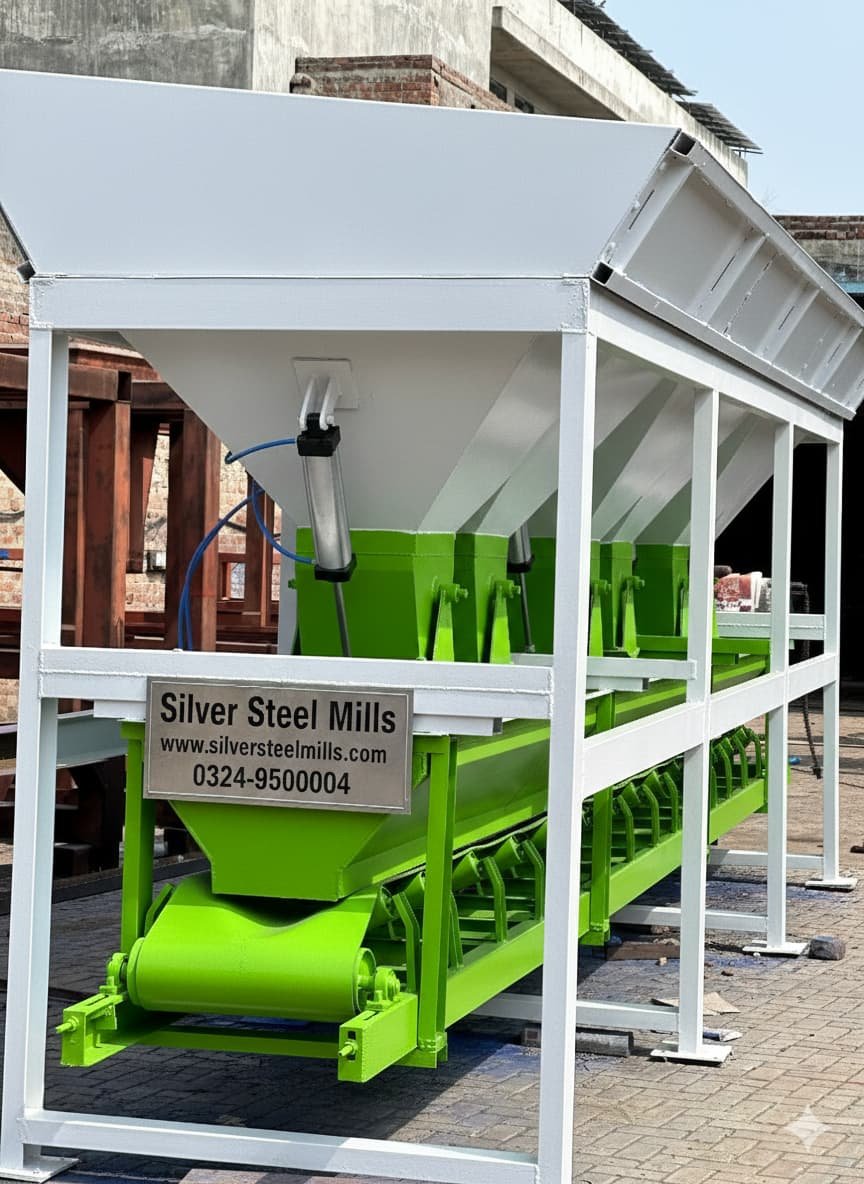
To achieve this level of high-density material compaction consistently without structural fracturing during mold stripping, commercial eco-block producers rely on heavy-duty equipment lines. High-volume sustainable factories commission their automated plants through proven local engineering firms like Silver Steel Mills, where high-tonnage concrete block making machines, automated aggregate weight batchers, and precision pan mixers are engineered with heavy reinforced steel frames to handle dense, fly-ash blended zero-slump mixes while maintaining optimal operational cost profiles.
Industrial Frequently Asked Questions (FAQs)
Q1: Does replacing cement with fly ash lower the early-stage strength of fresh blocks?
Answer: Yes. The pozzolanic reaction of Class F fly ash is slower than primary cement hydration. Blocks containing fly ash typically show slightly lower compressive strength during the first 3 to 7 days compared to pure OPC blocks. However, their strength curve continues to climb steadily over time, eventually exceeding the strength of pure cement blocks at 28 and 56 days of curing.
Q2: What is the ideal water-cement ratio when using fly ash in a dry block mix?
Answer: Because the smooth, spherical shape of fly ash particles naturally reduces water demand by 5% to 10% compared to angular cement grains, the water-cement ratio must be kept strictly between 0.30 and 0.33 for automated hydraulic compaction plants. Adding too much water will cause the molded “green” blocks to slump and lose their shape when stripped.
Q3: Can fly ash blocks reduce the occurrence of surface efflorescence (shora)?
Answer: Yes, significantly. Efflorescence happens when rainwater dissolves free lime [$text{Ca(OH)}_2$] inside the block and carries it to the surface, where it reacts with air to leave a white, powdery salt layer. Because the pozzolanic reaction consumes free lime and converts it into insoluble C-S-H gel, it removes the chemical source of efflorescence, keeping block surfaces clean.
Q4: Are fly ash concrete blocks compatible with steam curing chambers?
Answer: Yes, fly ash mixes respond exceptionally well to accelerated steam curing. Raising the curing chamber temperature to between 50°C and 65°C with 90% humidity accelerates the pozzolanic reaction kinetics. This allows fly ash blocks to achieve full handling and transport strengths within 12 to 18 hours, matching standard factory dispatch cycles.
Q5: How much cement can safely be replaced by Class F fly ash in load-bearing hollow blocks?
Answer: For load-bearing applications requiring a compressive strength above $5.0 text{ N/mm}^2$, the recommended replacement limit is 15% to 20% by weight of total cementitious material. Going beyond 25% without adding chemical accelerators can extend the setting time too much, which can cause cracking along the edges of thin block walls during mechanical handling.