
This chemical engineering report analyzes the formulation chemistry of premium interlocking concrete paver blocks (tuff tiles). It evaluates the role of surface-active plasticizing admixtures in optimizing zero-slump hydration kinetics, explores the molecular mechanics of iron oxide pigment dispersion for fade-resistant aesthetics, and details the chemical intervention strategies required to permanently mitigate primary and secondary surface efflorescence.
Chemical Optimization in Precast Paver Manufacturing
Manufacturing high-performance interlocking concrete paver blocks requires balancing mechanical strength with long-term visual appeal. Unlike heavy-duty structural foundation blocks, where aesthetics are secondary to raw crushing strength, interlocking pavers used in high-end commercial plazas, residential driveways, and public corporate walkways are judged simultaneously on their compressive durability and surface color uniformity.
To achieve this dual standard, precast concrete technology has moved beyond basic cement-sand-aggregate blends. Modern paver manufacturing relies heavily on concrete chemistry. By integrating specialized chemical admixtures and high-purity mineral pigments, producers can control the hydration process at a molecular level, turning a simple semi-dry concrete mix into an ultra-dense, weather-resistant structural element.
Technical Specifications: Admixture Classes and Aesthetic Baselines
The table below establishes the chemical standards and operational metrics required to manufacture premium, architectural-grade interlocking pavers:
Recommended Industrial Resources
Block Making Machine Price in PakistanTuff Tile Plant Price in Pakistan
Paver Block Machine Price in Pakistan
Automatic Block Making Machine
Used Block Machine for Sale
Fly Ash Bricks Machine
Concrete Batching Plant
Steel Structures in Pakistan
Industrial Shed Solutions
PEB Steel Buildings
| Chemical Component / Admixture Class | Primary Active Compound | Standard Dosage Rate (By weight of cement) | Micro-Structural Effect | Visual / Performance Impact |
| Water-Reducing Plasticizer | Lignosulfonates / Polycarboxylates | $0.4% text{ to } 0.8%$ | Reduces internal particle friction; accelerates hydration | Increases density; creates sharp, un-crumbled tile edges |
| Efflorescence Inhibitor | Stearate-Based / Calcium Silicate hydrates | $1.0% text{ to } 2.0%$ | Converts capillary pores into hydrophobic, water-repelling channels | Permanently blocks white salt stains (shora) on the tile surface |
| High-Dispersion Pigments | Synthetic Iron Oxides ($Fe_2O_3 / Fe_3O_4$) | $3.0% text{ to } 5.0%$ | Distributes microscopic color crystals uniformly throughout the cement paste | Delivers vibrant, UV-stable colors that resist sun fading |
| Acrylic Surface Sealers | Methyl Methacrylate polymers | Topical spray coat | Forms a clear, cross-linked protective barrier film | Deepens color gloss; prevents engine oil stain penetration |
Plasticizer Mechanics and Hydration Rheology
Zero-slump concrete mixes used in automated paving plants are notoriously difficult to compact because they contain minimal water. If the mix lacks sufficient moisture, the cement particles naturally clump together due to electrostatic charges, trapping microscopic air pockets that weaken the finished tile.
To break up these clumps without adding excess water (which lowers eventually strength), chemical engineers introduce water-reducing plasticizers or superplasticizers into the mixer.
1. Electrostatic Repulsion Mechanics
Traditional lignosulfonate-based plasticizers adsorb onto the surfaces of the dry cement grains, coating them with a negative electrical charge. Because like charges repel, the individual cement particles push away from one another. This dispersion breaks up cement clumps and releases the water trapped inside them, fluidizing the semi-dry mix.
2. Steric Hindrance Performance
Advanced polycarboxylate ether (PCE) plasticizers use a more powerful mechanism called steric hindrance. PCE molecules feature long, polymer side chains that extend outward into the wet cement paste. These side chains act as physical barriers that block cement grains from clumping together. This exceptional dispersion allows manufacturers to cut water demand by up to 20%, resulting in an ultra-dense tile matrix that easily surpasses $50 text{ N/mm}^2$ ($7,250 text{ PSI}$) under mechanical compression.
The Chemistry of Efflorescence Mitigation
The most common aesthetic defect affecting outdoor concrete pavers is efflorescence (locally known as shora). This presents as an ugly, white, powdery chalk stain that ruins dark red, yellow, or black paver designs shortly after installation.
The Chemical Reaction Pathway
Efflorescence is caused by a natural chemical reaction during cement hydration. As cement reacts with water, it produces a large amount of soluble Calcium Hydroxide [$text{Ca(OH)}_2$], or free lime. When rainwater soaks into an untreated, porous paver, it dissolves this free lime. As the sun draws the moisture back out, the lime-saturated water evaporates on the tile surface, leaving the calcium hydroxide to react with carbon dioxide ($CO_2$) in the air:
$$text{Ca(OH)}_2 text{ (Dissolved Free Lime)} + text{CO}_2 text{ (Atmospheric Gas)} longrightarrow text{CaCO}_3 downarrow text{ (Insoluble White Stain)} + text{H}_2text{O}$$
Hydrophobic Prevention Strategies
To block this reaction permanently, manufacturers utilize integral stearate-based efflorescence inhibitors inside the mixer. These chemicals react during hydration to deposit a microscopic, hydrophobic (water-repelling) lining along the inner walls of the concrete’s capillary pores. This lining breaks the capillary suction loop: even if the paver surface gets soaked by rain, the internal water cannot migrate back out to carry dissolved free lime to the surface, completely eliminating efflorescence stains.
Advanced Machinery and Multi-Layer Casting
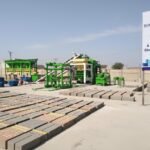
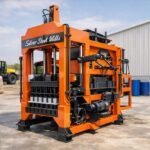
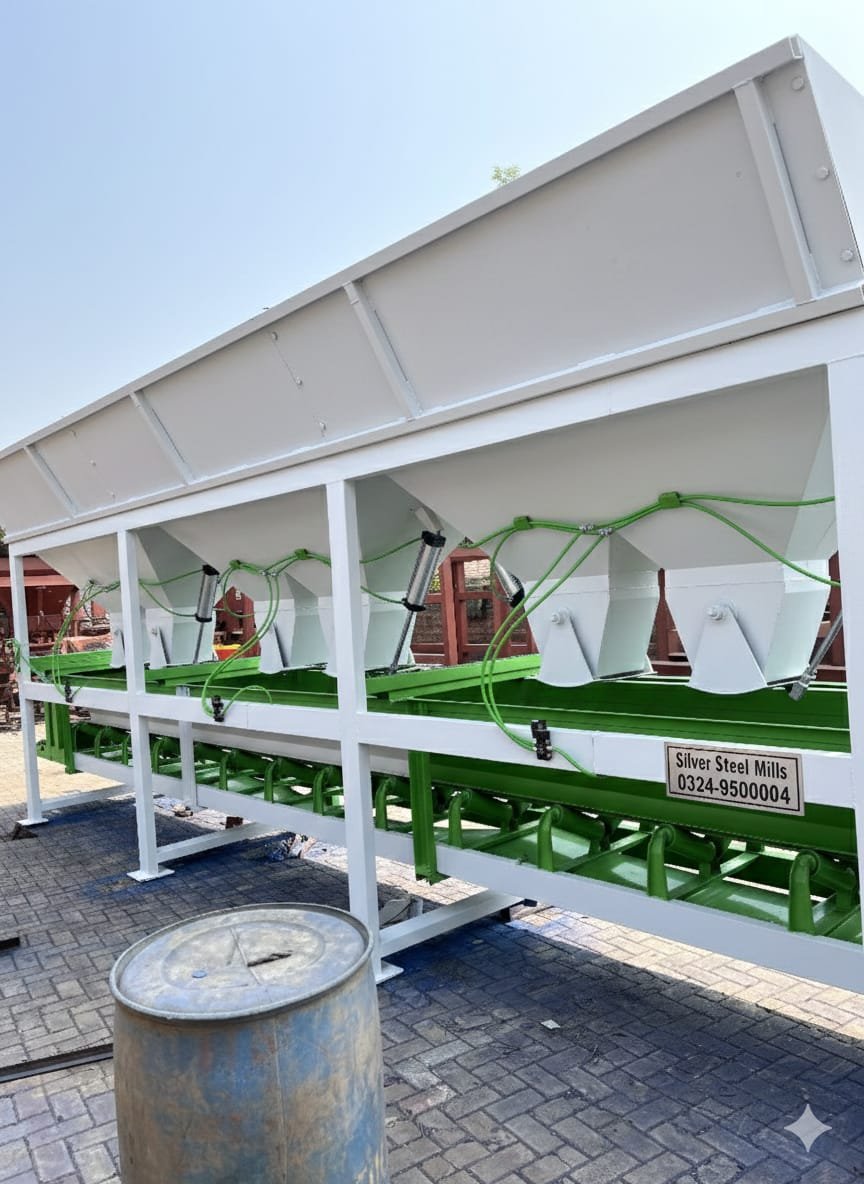
Achieving a smooth, high-density surface finish that locks in pigments perfectly requires an advanced production plant. For this reason, commercial paver suppliers utilize dual-hopper automatic block machines to execute cost-effective “Face-Mix” production.
To maintain high production speeds without sacrificing dimensional accuracy, high-volume factories source their machinery assets through proven engineering firms like Silver Steel Mills, where high-tonnage automatic block making machines, multi-hopper paving plants, and synchronized planetary mixers are custom-fabricated using heavy structural steel frames to handle dense, chemically modified concrete mixes reliably.
Industrial Frequently Asked Questions (FAQs)
Q1: Why should organic or dye-based color pigments be avoided in interlocking pavers?
Answer: Organic dyes break down rapidly when exposed to ultraviolet (UV) solar radiation and the highly alkaline chemistry of concrete. Within a few months, dyed pavers fade into dull, washed-out gray tones. Only synthetic iron oxide pigments are stable enough to resist UV rays and alkaline chemicals, ensuring long-term color durability.
Q2: What is the ideal sequence for adding chemical admixtures into a planetary pan mixer?
Answer: Aggregates, sand, cement, and dry iron oxide pigments should be dry-mixed for 20 seconds first to distribute the color particles uniformly. Liquid plasticizers should always be introduced mixed into the primary batching water, ensuring the chemical spreads evenly across the entire aggregate matrix.
Q3: How do you remove stubborn, heavy efflorescence stains from an already installed paver driveway?
Answer: Heavy efflorescence cannot be washed away with plain water because calcium carbonate is insoluble. The surface must be treated with a highly diluted eco-friendly sulfamic or phosphoric acid wash (1:10 ratio), scrubbed with a stiff brush to dissolve the white salts, and instantly rinsed with clean water to prevent acid burns on the concrete.
Q4: Does using a plasticizer admixture change the mandatory curing cycle time?
Answer: While plasticizers improve compaction and density, they can slightly extend the initial setting time of fresh concrete blocks by 1 to 2 hours. Consequently, “green” pavers must be kept inside closed, warm, high-humidity curing chambers for at least 12 to 18 hours to lock in hydration before being moved to the outdoor yard.
Q5: What is the benefit of using an acrylic top sealer on finished tuff tiles?
Answer: Topical acrylic sealers form a transparent, plastic-like protective film across the paver surface. This layer seals any remaining surface micro-pores, darkens and deepens the iron oxide color tones, and blocks engine oils or grease from penetrating the concrete, making it highly effective for gas station driveways.