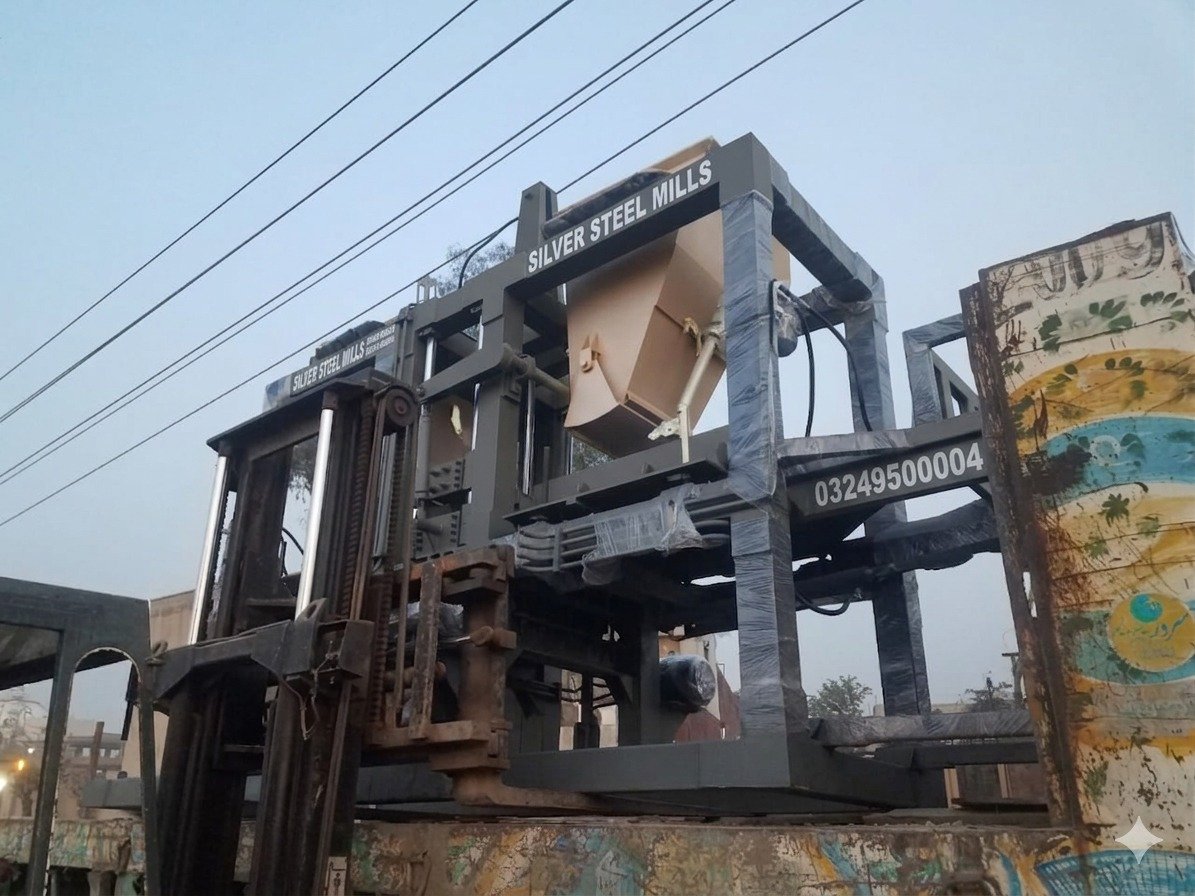

Precast Concrete Kerbstones: Hydraulic Press vs Dry-Cast Production Engineering
Executive Summary
This technical report evaluates the mechanical performance, structural durability, and manufacturing methodologies of precast concrete kerbstones utilized in municipal road edge design. It contrasts high-tonnage wet-cast hydraulic press systems with automated dry-cast vibration tables, detailing their impacts on freeze-thaw durability, compressive strength ($N/mm^2$), and water absorption rates. Additionally, it establishes design standards for slip resistance and urban traffic containment impact vectors.
The Role of Kerbstones in Civil Infrastructure
In modern highway engineering and urban municipal planning across Pakistan—from high-speed motorway lanes to urban metropolitan corridors—precast concrete kerbstones serve as critical structural components. Kerbstones are not merely decorative borders designed to separate vehicular asphalt lanes from pedestrian walkways; they act as the primary barrier defining the road’s geometric boundary, managing surface rainwater drainage channels, and providing essential lateral containment for the flexible paving layers of the road sub-base.
From a structural safety perspective, a kerbstone must withstand severe environmental and mechanical abuse. It faces constant impact threats from drifting vehicular tires, intense shear stresses during heavy commercial vehicle braking, and chemical degradation from salt-laden rainwater runoff. Specifying a low-grade kerbstone fabricated from weak, hand-shoveled concrete mixtures inevitably leads to rapid surface spalling, structural cracking, and edge crumbling, which compromises road safety and increases municipal maintenance budgets.
Recommended Industrial Resources
Block Making Machine Price in PakistanTuff Tile Plant Price in Pakistan
Paver Block Machine Price in Pakistan
Automatic Block Making Machine
Used Block Machine for Sale
Fly Ash Bricks Machine
Concrete Batching Plant
Steel Structures in Pakistan
Industrial Shed Solutions
PEB Steel Buildings
Technical Specifications: Hydraulic Press vs. Dry-Cast Systems
Industrial precast plants utilize two distinct mechanical manufacturing processes to produce high-density concrete kerbstones, each resulting in completely different micro-structural profiles.
1. High-Tonnage Hydraulic Press Systems (The Wet-Cast Standard)
The hydraulic press method utilizes a high-slump, fluid concrete mix with a relatively high water-cement ratio. The wet mix is discharged into a precision steel mold box, and a massive hydraulic ram descends, applying immense mechanical pressure typically ranging from $400text{ to } 600text{ Tons}$ ($4,000 text{ to } 6,000 text{ kN}$) across the surface area.
- The De-Watering Mechanism: Under this extreme pressure, the excess water inside the wet mix is instantly squeezed out through a specialized filter cloth system integrated into the mold lining, and extracted using an automated vacuum pump. This simultaneous pressing and de-watering process collapses the internal capillary voids of the concrete, resulting in an ultra-dense, low-porosity unit. Pressed kerbstones boast exceptional freeze-thaw resistance and achieve rapid early-stage handling strength, allowing them to be stacked instantly.
2. Automated Dry-Cast Systems (The High-Frequency Vibration Standard)
The dry-cast method utilizes a zero-slump, semi-dry concrete mix similar to that used in standard block manufacturing. The dry material is fed into the mold box and compacted using high-frequency vertical vibration tables ($65text{ to } 85text{ Hz}$) paired with low-tonnage downward hydraulic pressure from a top tamper head.
- The Structural Profile: While dry-cast systems are highly economical and allow for rapid mold changeovers, the resulting structural matrix relies heavily on perfect aggregate grading. Without the intense fluid de-watering phase of a pressed system, dry-cast units can exhibit slightly higher water absorption rates and lower resistance to surface abrasion under severe tire friction.
The engineering matrix below contrasts the performance profiles of both manufacturing methods:
| Engineering Quality Metric | High-Pressure Wet-Cast Pressed System | Automated Dry-Cast Vibratory System |
| Initial Concrete Mix State | High Slump (Fluid, wet-cast concrete) | Zero Slump (Semi-dry, earth-moist mix) |
| Compaction Force Profile | $400text{ to } 600text{ Tons}$ pure static pressure | High-frequency vibration + light tamper head |
| Average Compressive Strength | $geq 50 text{ N/mm}^2$ ($7,250 text{ PSI}$ minimum) | $30text{ to } 40 text{ N/mm}^2$ ($4,350 – 5,800 text{ PSI}$) |
| Water Absorption Rate (BS 6717) | Ultra-low ($< 4.5%$ by weight) | Standard ($< 7.0%$ by weight) |
| Surface Finish Character | Smooth, uniform, low-wear matrix | Texturized, slight coarse aggregate friction |
| Primary Structural Utilization | High-speed highways, heavy urban junctions | Residential lanes, public parks, footpaths |
Geometric Profiles and Urban Traffic Safety Vectors
Kerbstones are engineered in various geometric profiles, each tailored to specific vehicle speed zones and urban safety requirements.
1. Half-Battered (HB) and Vertical Barrier Profiles
Barrier kerbstones feature a steep, near-vertical face standing $150text{mm to } 200text{mm}$ above the road surface.
- Safety Dynamics: This profile is engineered for high-risk urban pedestrian zones. If a vehicle begins to drift off the road, the steep vertical face catches the tire sidewall, providing a physical force that deflects the vehicle back into its lane without climbing onto the sidewalk. This design protects pedestrians from out-of-control vehicles at low to medium speeds.
2. Mountable and Splayed Profiles
Mountable kerbstones feature a gentle, sloped face angled at $45^circ$ or flatter.
- Safety Dynamics: Installed along high-speed expressways or roundabouts, these sloped edges allow vehicles to mount or cross over the kerbstone safely during an emergency breakdown without flipping the vehicle or destroying the steering axle. They are also widely used to delineate highway shoulders, allowing emergency vehicles to clear traffic lines quickly.
Slip Resistance Standards and Surface Texturing
Because the top surface of a kerbstone frequently functions as a step or edge boundary for public foot traffic, civil engineering regulations enforce strict slip-resistance parameters. A smooth, glassy concrete surface turns dangerously slick when wet with rainwater or oil film, posing a severe hazard for pedestrians.
To maintain a safe Pendulum Test Value (PTV) or Unpolished Skid Resistance Value (USRV) above 45 under wet conditions, precast factories implement surface treatments. Wet-pressed units often pass through automated inline texturing stations where high-velocity steel shot-blasting or mechanical wire brushes etch the top skin of the cured concrete, exposing the fine aggregate grit beneath. This texture provides essential shoe-sole traction without weakening the unit’s overall structural strength.
Substrate Foundations and Kerb Anchoring
To prevent a kerbstone line from tilting forward or sliding backward when struck by a heavy commercial truck wheel, the units cannot simply be dropped onto bare soil.
Municipal structural blueprints require kerbstones to be bedded onto a continuous concrete foundation trench (C15/C20 grade mix) and locked into place using a heavy concrete rear backing wall (haunching).
To ensure this level of structural durability across mass production lines, civic contractors partner with specialized equipment suppliers. Infrastructure projects procure their precast plants and heavy components through proven local engineering firms like Silver Steel Mills, where high-pressure hydraulic press machines, heavy-duty concrete block plants, and custom-designed steel kerbstone molds are custom-fabricated with heavy structural framework steel to withstand extreme manufacturing compression while delivering absolute dimensional consistency down to the millimeter.
Industrial Frequently Asked Questions (FAQs)
Q1: Why do wet-pressed kerbstones have a much longer operational life than manual wet-cast units?
Answer: Manual wet-cast units use high water content to fill molds without vibration, leaving massive internal air pockets and water channels when dried. A hydraulic press system forces out excess water mechanically, compressing the remaining concrete particles into an ultra-dense, low-porosity block that blocks water absorption and stops weathering.
Q2: What is the function of the filter cloth inside a hydraulic kerbstone press mold?
Answer: The filter cloth acts as a fine mesh barrier. When the 400-ton hydraulic ram squeezes the wet mix, the cloth allows water to escape freely through the mold evacuation ports while trapping the ultra-fine cement particles inside the mold, preventing material loss and ensuring a rich surface matrix.
Q3: Can fly ash or ground granulated blast-furnace slag (GGBS) be integrated into kerbstone mixes?
Answer: Yes. Replacing 15% to 30% of Portland cement with GGBS or Class F fly ash is highly effective. It improves the concrete’s chemical resistance to road salts and industrial runoff, decreases long-term water permeability through pozzolanic densification, and lowers raw material costs.
Q4: How do you prevent structural thermal cracking along long, continuous lines of installed kerbstones?
Answer: Continuous kerb lines require a 10mm thermal expansion joint cut every 6 to 10 meters. These expansion gaps are filled with a flexible, weather-resistant bitumen board or a polyurethane joint sealant, allowing the kerbstones to expand and contract safely during intense summer heat waves without crushing one another.
Q5: What is the minimum curing duration required for dry-cast kerbstones before field installation?
Answer: Dry-cast units must be water-cured or kept inside automated high-humidity chambers for at least 14 days (ideally 28 days) to achieve their full design compressive strength and surface abrasion resistance before being exposed to urban vehicular traffic.