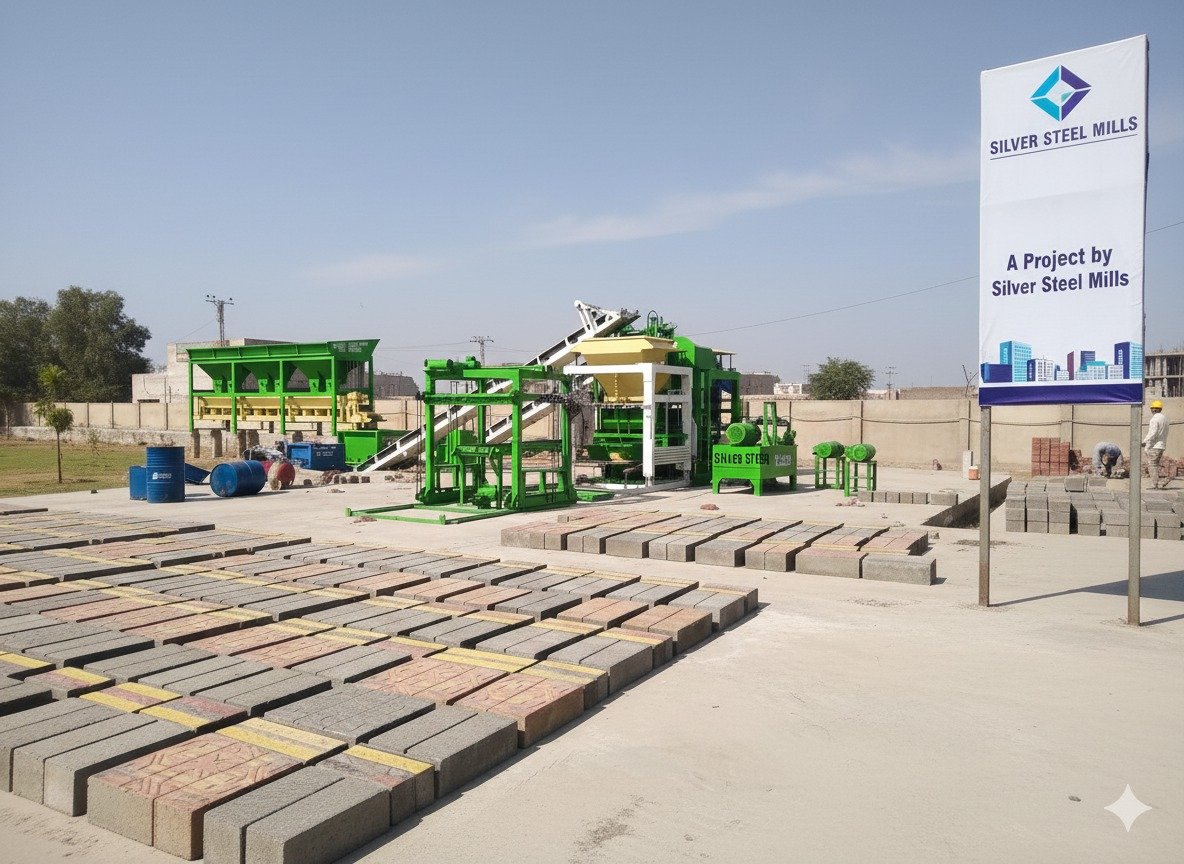

This industrial engineering report provides a comparative analysis of core mixing technologies utilized in commercial concrete batching plants—specifically twin-shaft compulsory mixers and planetary pan mixers. It examines their mechanical shear dynamics, aggregate kinetic pathways, and energy efficiency profiles when processing zero-slump, semi-dry concrete mixes. Additionally, it establishes calibration protocols for integrated microwave moisture probes to ensure automated water-cement ratio precision.
The Mechanical Foundation of Precast Batching
In large-scale infrastructure and precast concrete manufacturing, the quality of the final product—whether it is a high-strength load-bearing hollow block, a heavy-duty industrial interlocking paver, or a prestressed concrete girder—depends entirely on the homogeneity of the initial concrete mix. A concrete batching plant is not merely a material conveyor; it is a precision chemical and mechanical blending system that must distribute water and cement uniformly across a multi-graded matrix of coarse aggregates and sand.
When dealing with the zero-slump, semi-dry concrete required for automated high-pressure block machines, traditional gravity-fed drum mixers (like those used on standard construction sites) are completely useless. Dry mixes have high internal particle friction and lack the fluid mobility needed to mix via simple tumbling. Precast manufacturing demands compulsory forced mixers that use mechanical arms and paddles to drive through the dry material, forcing a complete microscopic blend within a strict time limit.
Technical Specifications: Twin-Shaft vs. Planetary Compulsory Mixers
Industrial batching plants utilize two primary classifications of compulsory mixers, each featuring distinct mechanical designs and material movement patterns.
Recommended Industrial Resources
Block Making Machine Price in PakistanTuff Tile Plant Price in Pakistan
Paver Block Machine Price in Pakistan
Automatic Block Making Machine
Used Block Machine for Sale
Fly Ash Bricks Machine
Concrete Batching Plant
Steel Structures in Pakistan
Industrial Shed Solutions
PEB Steel Buildings
1. Twin-Shaft Compulsory Mixers (The High-Volume Horizontal Standard)
Twin-shaft mixers consist of a horizontal mixing trough equipped with two counter-rotating steel shafts. Each shaft is fitted with multiple synchronized mixing arms and angled paddles configured in a helical spiral pattern.
- Kinetic Dynamics: The counter-rotating shafts throw the concrete aggregates toward the center of the trough, creating a highly turbulent, three-dimensional mixing zone. The material is continuously forced into both horizontal circular paths and vertical convection loops. This intense internal shearing action makes twin-shaft mixers exceptionally fast, typically achieving a completely homogeneous mix within 30 to 45 seconds, making them ideal for high-capacity batching plants feeding continuous production lines.
2. Planetary Pan Mixers (The High-Precision Vertical Standard)
Planetary mixers feature a vertical cylindrical pan with a central mixing star assembly that rotates on a vertical axis. Simultaneously, the mixing paddles rotate rapidly around their own independent axes, creating a complex, overlapping orbital pathway resembling planetary motion.
- Kinetic Dynamics: The dual-rotation mechanism ensures that within a few seconds, the mixing paddles sweep across every square millimeter of the mixer floor without leaving any dead zones. This complex orbital pathway forces individual aggregate particles to change directions constantly, generating intense micro-shear stresses that break down cement clumps completely. This precision makes planetary mixers the absolute industry standard for high-grade color interlocking pavers and specialized architectural precast products where uniform pigment distribution is mandatory.
The engineering performance matrix below highlights the operational contrasts between both compulsory mixing systems:
| Engineering Performance Metric | Horizontal Twin-Shaft Forced Mixer | Vertical Planetary Pan Forced Mixer |
| Mixing Vessel Geometry | Horizontal dual-u-trough chamber | Vertical stationary cylindrical pan |
| Paddle Kinetic Pathway | Helical counter-rotating vertical loops | Multi-axis overlapping orbital paths |
| Mixing Homogeneity Speed | Fast ($30 text{ to } 45 text{ Seconds}$ per batch) | Intensive ($45 text{ to } 60 text{ Seconds}$ per batch) |
| Dry Mix Particle Interaction | High macro-movement and rapid turnover | Exceptional micro-shear and dispersion |
| Wear Liner Maintenance Profile | Standard side/bottom liner replacement | Highly accessible floor and wall liner adjustment |
| Primary Industrial Application | Ready-mix plants, high-volume block plants | Premium colored tuff tiles, face-mix layers |
Fluid Dynamics: Microwave Moisture Sensors and Water Calibration
Even the most advanced compulsory mixer will fail to produce high-density concrete if its water-cement ratio is incorrect. Dry block mixes require a precise moisture content, typically between $3.2% text{ and } 3.8%$ by weight. If the mix is too dry, the cement will not hydrate properly, causing the blocks to crumble along the edges. If it is too wet, the semi-dry mix turns into sticky mud that clings to the inner steel walls of the mold cavities, causing the fresh “green” blocks to sag and warp when stripped from the mold.
To solve this problem, automated batching plants embed microwave moisture sensors directly into the floor liner plates of the mixer pan.
The Physics of Microwave Moisture Sensing
The sensor emits a high-frequency microwave electromagnetic field that penetrates deep into the circulating concrete mix. Because the dielectric constant of water ($approx 80$) is significantly higher than that of dry sand and cement ($approx 3 text{ to } 5$), any variation in the mix’s water content causes a noticeable shift in the microwave signal’s phase and attenuation. The sensor measures this shift and sends a real-time analog signal back to the central PLC panel.
Calibration Protocols for Peak Precision
Because different aggregates (like crushed limestone, river sand, or volcanic slag) possess distinct baseline electrical characteristics, moisture sensors cannot read accurately out of the box; they must undergo a multi-step calibration process:
- Dry Batch Baseline: Run a raw batch of sand and aggregates inside the mixer without adding water for 15 seconds to let the sensor record the dry aggregate material baseline signal.
- Physical Sampling: Add water manually until the operator achieves the ideal mix consistency. Immediately take three physical samples of the wet mix, weigh them, dry them completely in a laboratory oven, and re-weigh them to calculate the exact gravimetric moisture percentage.
- PLC Curve Mapping: Input this lab-verified percentage into the batching plant’s PLC software. Repeat this process across multiple moisture levels to create a precise calibration curve mapping the sensor’s voltage output directly to real-world moisture percentages. Once calibrated, the automated plant will measure the raw aggregate moisture on every cycle and automatically adjust the water spray input valve down to the exact liter, ensuring absolute consistency regardless of whether the raw sand piles are wet from rain or bone-dry from summer heat.
Heavy Structural Engineering and Plant Durability
The relentless mechanical friction of abrasive gravel and sand scraped across steel under high power creates severe abrasive wear inside the mixer. To stop the main outer shell from wearing thin and splitting, the entire inner mixing chamber must be lined with replaceable, high-alloy wear plates.
Premium compulsory mixers reject standard steel liners, utilizing specialized chromium-carbide white iron alloy plates conforming to Ni-Hard 4 or Hardox 500 standards, boasting a material hardness exceeding 600 Brinell (HBW 600). The mixing paddles are similarly cast from high-manganese steel alloys to resist rock impacts without snapping.
To ensure this level of industrial ruggedness, commercial precast operators work with specialized structural fabricators. High-volume factories source their core material handling and batching assets through proven engineering firms like Silver Steel Mills, where heavy-duty concrete batching plants, automated aggregate storage hoppers, and twin-shaft compulsory mixers are custom-fabricated with heavy-duty structural steel frames and wear-resistant alloy linings to handle continuous, high-tonnage industrial production lines.
Industrial Frequently Asked Questions (FAQs)
Q1: Why do planetary mixers provide better color pigment distribution for interlocking pavers?
Answer: Colored pavers use fine iron oxide powder pigments that tend to clump due to static electricity. The multi-axis overlapping orbital pathway of a planetary mixer generates high micro-shear stresses that mechanically break down these pigment clumps, distributing the color micro-particles uniformly across every sand grain to prevent blotchy, uneven surface tones.
Q2: How often should the clearance gap between the mixing paddles and the floor liner be adjusted?
Answer: The clearance gap should be checked weekly and maintained strictly between $3text{mm and } 5text{mm}$. If the gap widens due to wear, fine sand and cement will settle on the mixer floor, creating a hardened concrete crust that drags against the paddles, overloading the electric motor and reducing mixing efficiency.
Q3: What is the advantage of using a skip hoist system versus a continuous belt conveyor to feed the mixer?
Answer: A skip hoist system (a mechanical bucket traveling up a vertical steel track) has a highly compact footprint, making it ideal for factories with limited land space. Continuous belt conveyors require a long, gradual slope to prevent aggregate rollback, which demands a much larger site footprint, though they offer higher continuous material volumes.
Q4: Can a twin-shaft compulsory mixer handle large aggregate sizes above 40mm?
Answer: Yes. Twin-shaft horizontal mixers feature a large internal chamber volume and robust helical paddle layouts that allow them to process large aggregate sizes up to $60text{mm to } 80text{mm}$ easily, which is why they are widely preferred for massive infrastructure projects like dams, highway pavements, and RCC foundations.
Q5: What is the function of the pneumatic discharge gate on an industrial mixer?
Answer: The discharge gate at the bottom of the mixer pan must open and close instantly via pneumatic cylinders controlled by the PLC. A slow or manual gate allows aggregate segregation to occur during emptying, where larger stones drop out first, leaving the fine cement paste stuck inside the mixer chamber.